

Last Updated on September 16, 2026 by Jeremy
Quick answer: When an RV outlet stops working or the lights suddenly dim, the fastest solution begins with one question: is the problem on the 12-volt DC side, the 120-volt AC side, or at the power source?
This guide helps you identify the affected system, complete safe owner checks, and recognize when to stop. RV electrical layouts vary, so use your RV, inverter, converter, battery, generator, and energy-management manuals for model-specific procedures.
Start with the symptom: Open the free RV System Troubleshooter for a guided path through common RV problems.
Stop immediately when electrical trouble may be dangerous
Disconnect from shore power and stop using the affected equipment if you notice burning odours, smoke, sparks, melted insulation, a hot plug or receptacle, repeated breaker trips, buzzing or arcing, water in electrical equipment, or a shock or tingling sensation from the RV. Move away and seek emergency help if there is smoke or fire.
Do not remove covers from energized equipment, work inside the breaker panel, defeat a fuse or breaker, or continue resetting a protective device. A qualified RV technician or licensed electrician should diagnose these conditions.
Understand the two main RV electrical systems
12-volt DC
The house batteries normally supply lighting, the water pump, control boards, fans, slides, jacks, and other low-voltage equipment. A converter/charger typically changes 120-volt AC power into 12-volt DC power and charges compatible batteries when shore or generator power is available. Solar charge controllers and vehicle charging systems may also charge the batteries.
120-volt AC
Shore power, a generator, or an inverter may supply household-style outlets and higher-demand appliances. Breakers protect AC circuits, while GFCI devices protect outlets in locations where shock risk is higher. An inverter changes battery DC power into AC power for the circuits connected to it; it is not the same device as a converter/charger.
Quick symptom guide
| Symptom | Likely area | Safe first checks |
|---|---|---|
| Entire RV has no power | Power pedestal, shore cord, transfer equipment, main breaker, battery disconnect, or discharged battery | Confirm the source is available, cords are fully seated, disconnect switches are in the expected position, and no visible damage or overheating is present. |
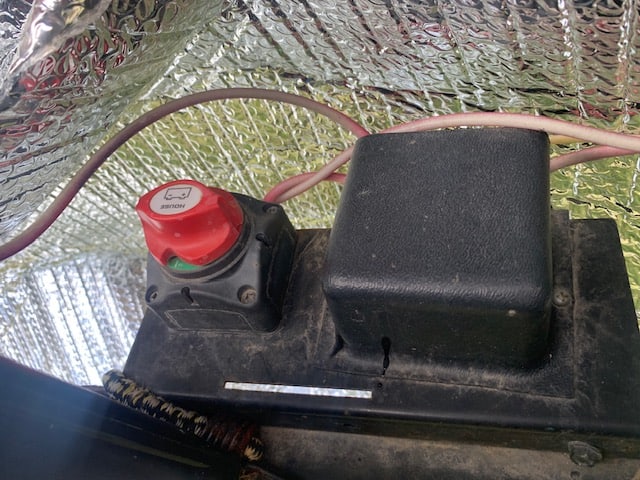
| Lights and water pump are dead, but outlets work | 12-volt system, converter output, battery disconnect, battery, or DC fuse | Check the disconnect position and labelled DC fuse panel; inspect the battery area for obvious loose or damaged connections only when it is safe. |
| Outlets are dead, but lights work | 120-volt supply, breaker, GFCI, inverter-fed circuit, or individual receptacle | Confirm shore/generator/inverter status, then check the labelled breaker and GFCI reset after removing loads and resolving any obvious cause. |
| Batteries do not charge on shore power | Converter/charger, breaker, fuse, battery disconnect, wiring, settings, or battery condition | Verify the charger is powered and configured for the installed battery type; use model-specific diagnostics or seek service. |
| Lights dim or equipment resets | Low battery voltage, weak battery, loose connection, excessive load, or charging fault | Reduce loads and check the battery monitor or approved test point. Heat, swelling, odour, or damaged cables require immediate service. |
| Breaker or fuse trips repeatedly | Overload, short circuit, failing appliance, damaged wiring, moisture, or incorrect protection | Unplug or turn off loads. Do not increase fuse or breaker size; arrange diagnosis if the device trips again. |
If the whole RV has no power
- Determine whether both 12-volt equipment and 120-volt outlets are dead.
- Inspect the shore-power cord, plug, adapter, and pedestal for visible damage, heat, or moisture before touching or reconnecting anything.
- Confirm the campground pedestal or home receptacle is actually providing the correct service. Do not use improvised adapters or undersized extension cords.
- Check the RV’s battery-disconnect position and labelled main breaker only after loads are off and no hazard is present.
- If the RV uses an automatic transfer switch, energy-management system, inverter/charger, or generator, follow that equipment’s diagnostic procedure.
If the RV’s 12-volt system is failing
A battery monitor may show state of charge, but voltage alone does not always prove battery health. Confirm that disconnect switches, charger settings, and battery type are correct. Look for loose, corroded, overheated, or damaged connections without contacting exposed conductors.
A blown fuse normally indicates an overload or fault. Replace it only with the same specified type and rating after correcting the cause. If it blows again, stop. Never install a larger fuse to keep the circuit operating.
Lithium and lead-acid batteries have different charging, temperature, storage, and safety requirements. Follow the battery and charger manufacturers; do not apply generic charging advice across chemistries.
If outlets or appliances have no 120-volt power
Confirm whether all outlets are affected or only one circuit. A single tripped GFCI can disable other outlets downstream, sometimes in a different part of the RV. Disconnect appliances, correct any water or load issue, and reset the appropriate GFCI once. If it will not reset or trips again, arrange service.
For a tripped breaker, switch off the connected loads. Follow the panel instructions to reset it once. Repeated trips, heat, noise, or discolouration point to a fault that should not be bypassed.
If the batteries are not charging
First identify which charging source has failed: shore power, generator, solar, or vehicle charging. If shore-power appliances work but battery voltage continues falling, the converter/charger may lack AC input, have a blown protection device, be configured incorrectly, or have an output, wiring, or battery problem.
Some inverter/chargers include charging limits, battery-type settings, remote panels, and error codes. Record the code and consult the exact manual before changing settings. Incorrect settings can damage batteries or create a safety hazard.
Shore-power and surge protection
Before connecting, inspect the pedestal, receptacle, plug, and cord. A quality RV electrical-management system can detect several power-source problems and disconnect the RV when conditions fall outside its protection limits. Progressive Industries provides model-specific operating manuals and troubleshooting resources for its RV surge protectors and electrical-management systems.
Protection equipment does not make a damaged pedestal, adapter, cord, or RV circuit safe. If a device reports a wiring fault or refuses to connect, investigate the cause instead of bypassing it.
What owners can check—and what requires a professional
Reasonable owner checks: reading displays and fault codes, confirming switch positions, turning loads off, inspecting accessible cords and plugs, checking labelled fuses or breakers, resetting a GFCI once, and following the manufacturer’s non-invasive diagnostic steps.
Professional work: opening energized panels, testing live high-voltage circuits, repairing pedestal or transfer-switch wiring, investigating shocks or hot-skin conditions, correcting repeated trips, repairing inverter/converter internals, and diagnosing burned, melted, wet, or damaged wiring.
Prevent recurring RV electrical problems
- Know the limits of 30-amp, 50-amp, and 15/20-amp service and manage simultaneous appliance loads.
- Use cords, adapters, chargers, fuses, breakers, and protection devices approved for the application.
- Keep electrical equipment dry and inspect connections for heat or damage.
- Maintain batteries according to chemistry and manufacturer instructions.
- Record faults, repairs, and battery replacements in the RV Maintenance Tracker.
- Use the Trusted Brand Directory to find RV electrical and power-system companies.
Frequently asked questions
Why do my RV lights work when the outlets do not?
The lights are usually powered by the 12-volt system, while household-style outlets require 120-volt power. Check the shore, generator, or inverter source, then the appropriate breaker and GFCI.
Why do the outlets work when the RV lights do not?
This usually points to the 12-volt side: battery disconnect, battery condition, converter output, wiring, or a DC fuse. The 120-volt supply can remain available while the 12-volt system is interrupted.
Can I keep resetting a breaker or replacing a fuse?
No. A protective device that operates repeatedly is reporting an overload or fault. Remove loads, correct the cause, and have the circuit diagnosed if it happens again.
Is an inverter the same as a converter?
No. An inverter produces AC power from battery DC power. A converter/charger uses AC input to produce DC power and typically charge the house batteries. Combination inverter/chargers perform both functions.
Do I need an RV surge protector?
Electrical protection is a sensible part of connecting to unfamiliar power sources. Compare simple surge protection with full electrical-management features, and choose equipment matched to your RV’s amperage and wiring.
Useful electrical diagnostic gear
Depending on your training and RV, useful equipment may include a non-contact voltage detector, polarity/GFCI tester, battery monitor, multimeter with an appropriate safety rating, spare manufacturer-specified fuses, and an RV electrical-management system. Tools do not replace safe procedures or model-specific instructions.
Affiliate disclosure: Some product links on this page may earn us a commission at no additional cost to you. Product links are placed after the troubleshooting guidance so safety and diagnosis come first.


Leave a Reply