

Last Updated on September 14, 2026 by Jeremy
Work camping sounds suspiciously simple when somebody describes it from the outside: park the RV somewhere beautiful, do a few chores, collect a paycheque or a free campsite, and spend the rest of the summer beside the lake. We believed a version of that too.
Then our family operated British Columbia provincial campgrounds for four seasons. We checked in guests, cleaned toilets and campsites, sorted recycling, hauled garbage, distributed firewood, made supply runs, managed employees, monitored essential services and dealt with problems that rarely waited for a convenient time. One season ended roughly a month early because of wildfire conditions. We did not even realize our final working day had already happened until two days later.
Work camping can still be a remarkable way to earn, travel and live together. It gave our family something a normal workplace rarely could: time in the same place, shared responsibility and the chance to learn from one another. But it is not automatically easy, free or financially fair. This guide explains the full picture we wish we had understood before our first season.
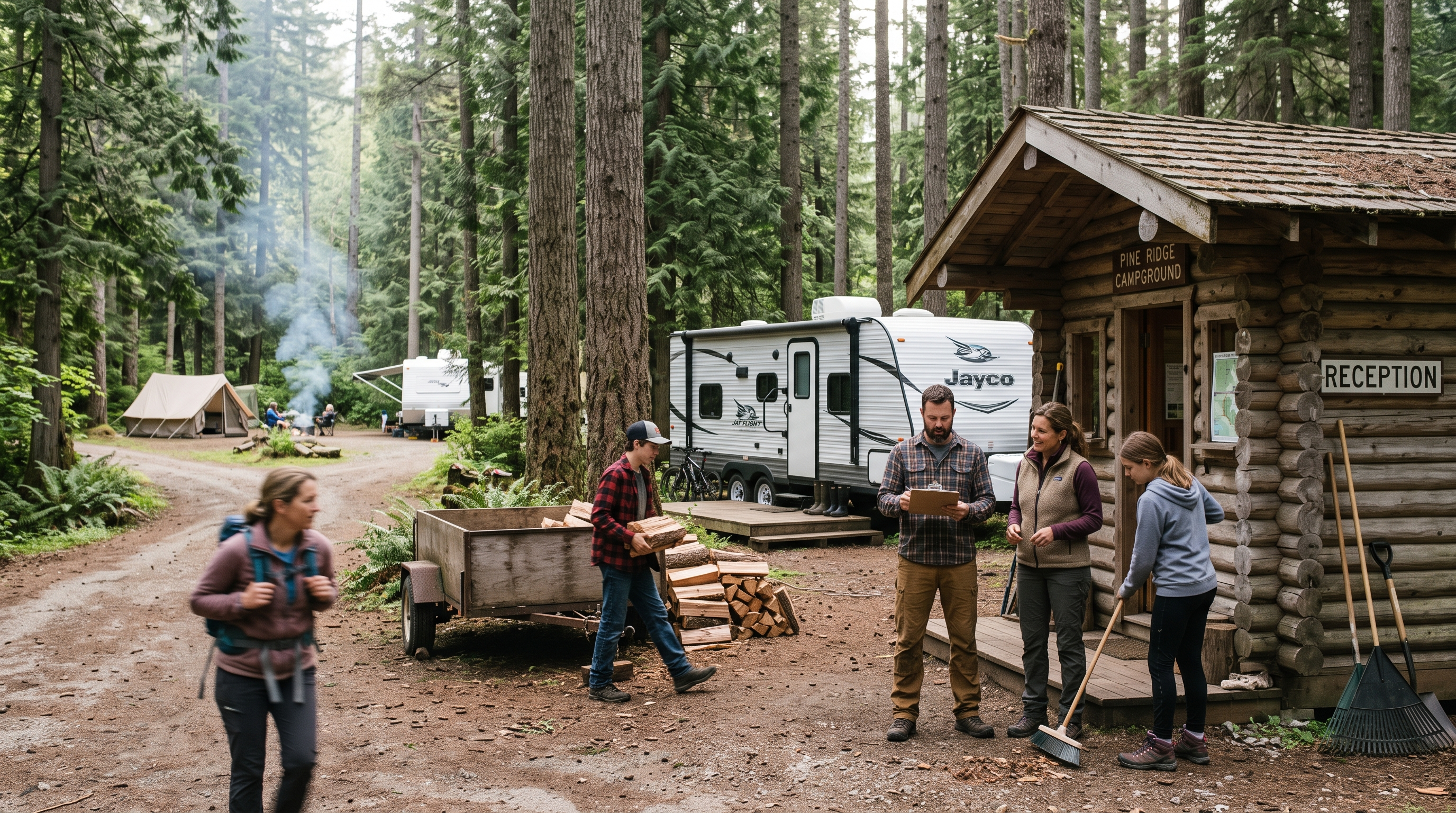
Living at the campground can bring a family together, but it also means the workplace follows you home. Illustrative AI-generated image; the experiences in this article are real.
TL;DR: What Work Camping Really Means
- Work camping is broader than campground hosting. It can include paid employment, volunteering, running a business or exchanging labour for an RV site or other value while living in an RV.
- Compensation varies dramatically. Some positions provide only a campsite. Others provide wages, a site, utilities, bonuses or a combination.
- Living onsite changes the meaning of “off duty.” A firewood request, late arrival or emergency can find you even when your scheduled workday has ended.
- Families can do it. We did, although employers, housing arrangements and whether children can be hired differ from one opportunity to another.
- Track the real hours. Quiet afternoons can disguise how demanding weekends, emergencies and after-hours interruptions become.
- Calculate the campsite’s actual value. Do not accept an inflated nightly retail rate as the value of a seasonal employee site.
- Get the arrangement in writing. Ask about wages, site deductions, utilities, days off, overtime, duties, pets, family members and early closures.
- Our verdict: worthwhile for the right family or RVer, but only when the compensation and boundaries make sense.
What Is Work Camping?
Workamper News, which coined and trademarked the term in the 1980s, defines Workampers broadly as individuals, couples and families combining part-time or full-time work with RV camping. The work does not have to happen in a campground, and the person does not have to be retired.
In practical use, work camping and workamping usually describe people living in an RV while exchanging their time or skills for something of value. That value might be money, an RV site, utilities, housing, commissions or experience. Workampers can be employees, independent contractors, volunteers or business owners, depending on the arrangement.
Hours for a Campsite
You provide a defined number of hours in exchange for an RV site, hookups or both. Extra hours may or may not be paid.
Wages Plus a Site
You receive hourly or salaried compensation and an onsite RV space. The site could be included, subsidized or deducted.
Hosting or Stewardship
You donate time while receiving a site or other non-cash benefit. The responsibilities should still be clearly defined.
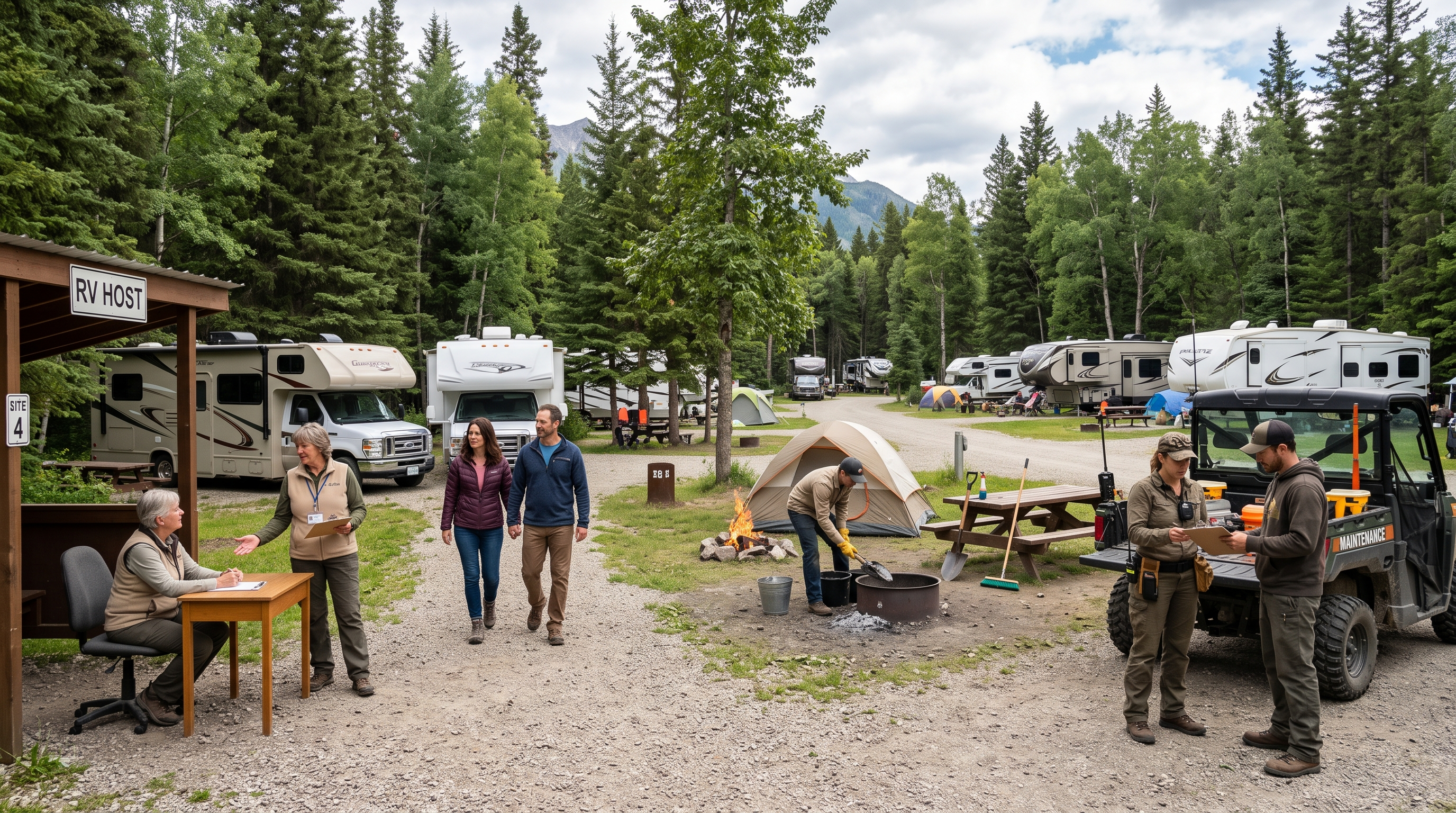
The phrase “work camping” can cover everything from light hosting duties to full campground management.
Our Four Seasons: From Two Operators to a Family Management Team
We found our first park opportunity through Indeed and applied to the private contractor responsible for those BC Parks campgrounds. That is worth clarifying because visitors often assume everyone working in a provincial park is directly employed by the provincial government. In many locations, that is not how the operating structure works.
| Our first two seasons | Our next two seasons |
|---|---|
| Setting: Silver Beach near Seymour Arm, with additional remote responsibilities as assigned. | Setting: Kentucky-Alleyne, a larger operation with several loops and more staff. |
| Role: Jessica and I handled day-to-day park operations together. | Role: we became campground managers and were responsible for a wider operating system. |
| Pay structure: our weekly pay was based on 40 hours whether a particular week contained many short days or several very long ones. | Pay structure: hourly work up to 40 hours per week, with schedules managed tightly to avoid overtime where possible. |
| Family arrangement: the two of us were employed. Our daughters had their own routines and helped us adapt to life onsite without being employees. | Family arrangement: we were able to hire our daughters, giving them paid responsibilities and real work experience. |
| Time off: there were no conventional scheduled days off, although many afternoons contained substantial downtime. | Time off: days off were scheduled, but being the onsite managers made truly disconnecting complicated. |
How Many Hours Do Workampers Actually Work?
There is no universal answer. During our first two seasons, some days demanded roughly four hours of active work. On eventful days, especially around busy weekends or unusual incidents, the day could stretch to 12 or even 16 hours. The weekly arrangement was built around 40 hours, but the workload did not arrive in five tidy eight-hour blocks.
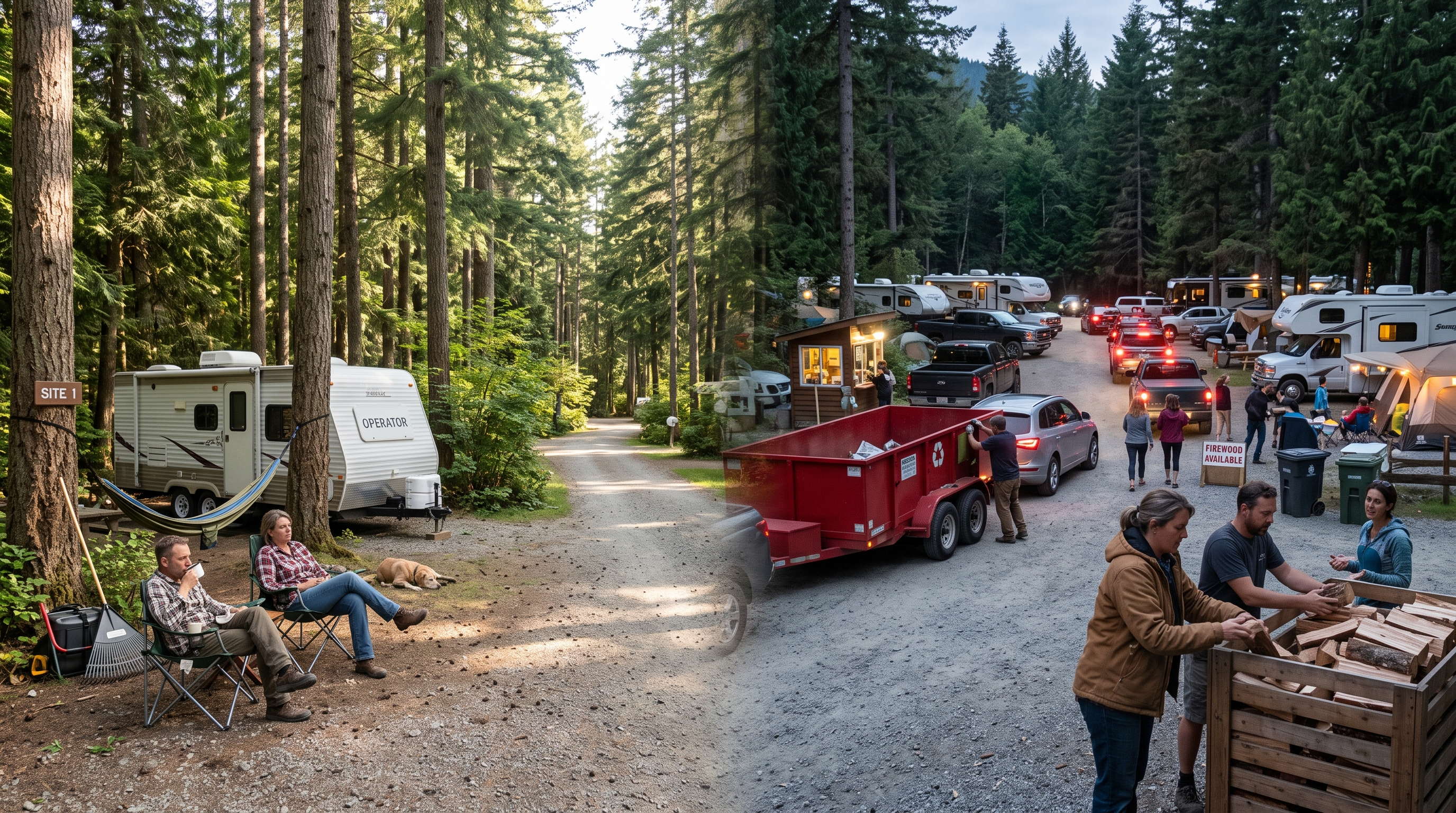
The same job can contain a nearly empty Tuesday afternoon and a weekend that refuses to end.
At Seymour, our rhythm was closer to being available every day with downtime woven between rounds and responsibilities. At Kentucky-Alleyne, the company required scheduled days off. That sounded healthier on paper, but management does not always respect a calendar. Campers arrived after hours, somebody wanted firewood, staff needed an answer or a facility problem needed attention. When your RV is parked inside the workplace, the distance between “working” and “not working” may be measured in steps.
What Campground Operators Actually Do
The old version of this article made work camping sound like campground hosting with a little maintenance added. Our experience became much broader than that.
At Seymour
- Registering guests in a first-come, first-served campground
- Cleaning bathrooms and checking supplies
- Raking sites, cleaning tables and emptying firepits after departures
- Emptying garbage and sorting recycling
- Distributing firewood
- Making supply and service runs
- Monitoring rules, fire restrictions and visitor concerns
At Kentucky-Alleyne
- Managing the normal check-in, cleaning and site turnover work
- Hiring, scheduling and, when necessary, dismissing employees
- Monitoring garbage collection and sanitation needs
- Ensuring outhouse pumping was arranged
- Coordinating maintenance, supplies and operational priorities
- Responding to staff, campers, day users and unexpected incidents
- Keeping a much larger campground system moving
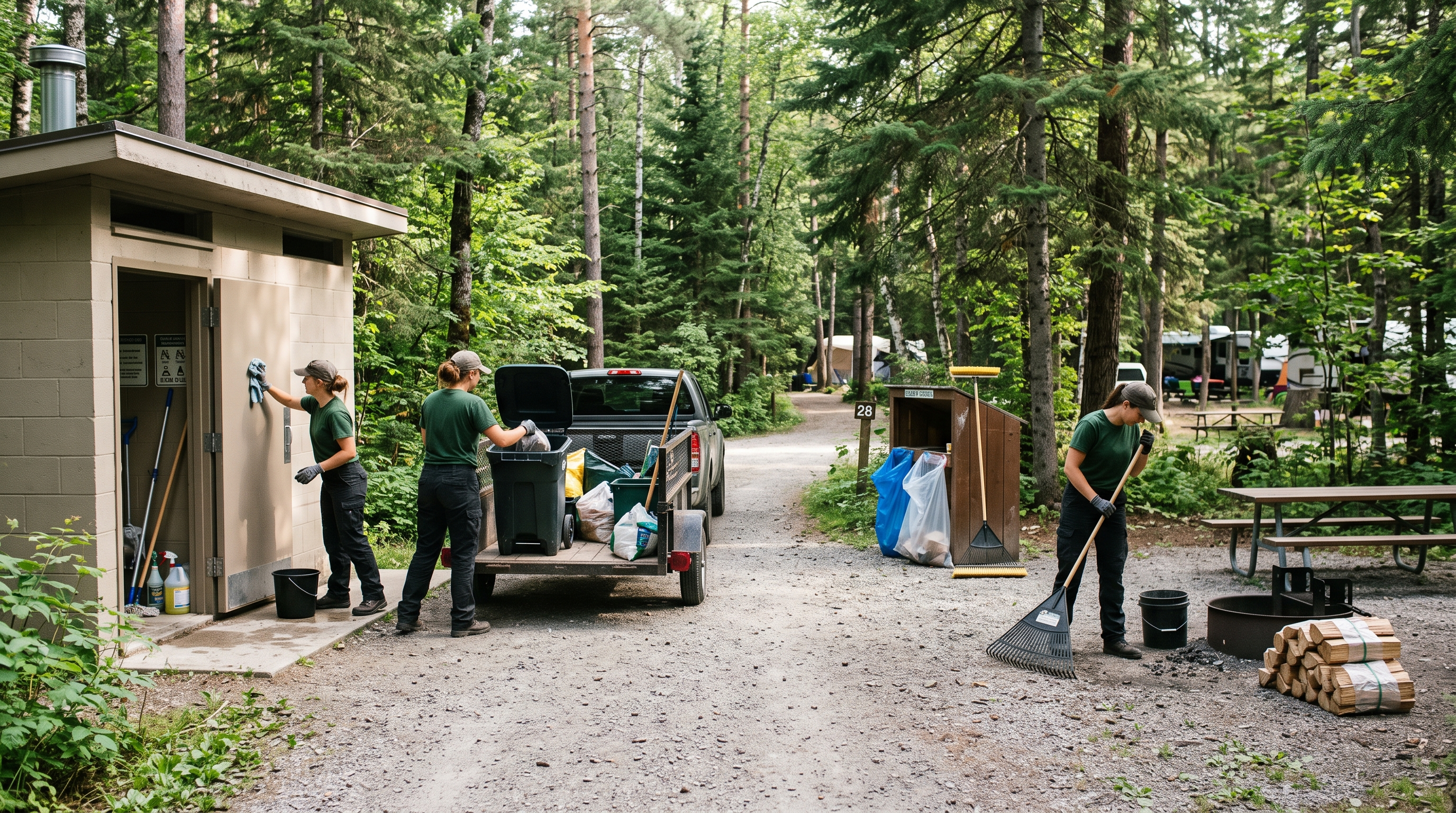
The visible interaction at check-in is a small part of what keeps a campground operating.
One passage in my book describes campground management as requiring a plumber, carpenter, landscaper and traffic cop. That is not much of an exaggeration. A seasonal job description can list the predictable work; it cannot list every broken fixture, unsafe fire, blocked road, staffing issue or confused camper that will appear during the season.
The Difference Between Hosting and Managing
A hosting position generally emphasizes presence, visitor information and light duties. A paid operator or manager may be responsible for revenue collection, sanitation, maintenance, employees, enforcement, supplies, security and coordination with the contractor or park authority. The words used in a job advertisement do not always reveal the real scope.
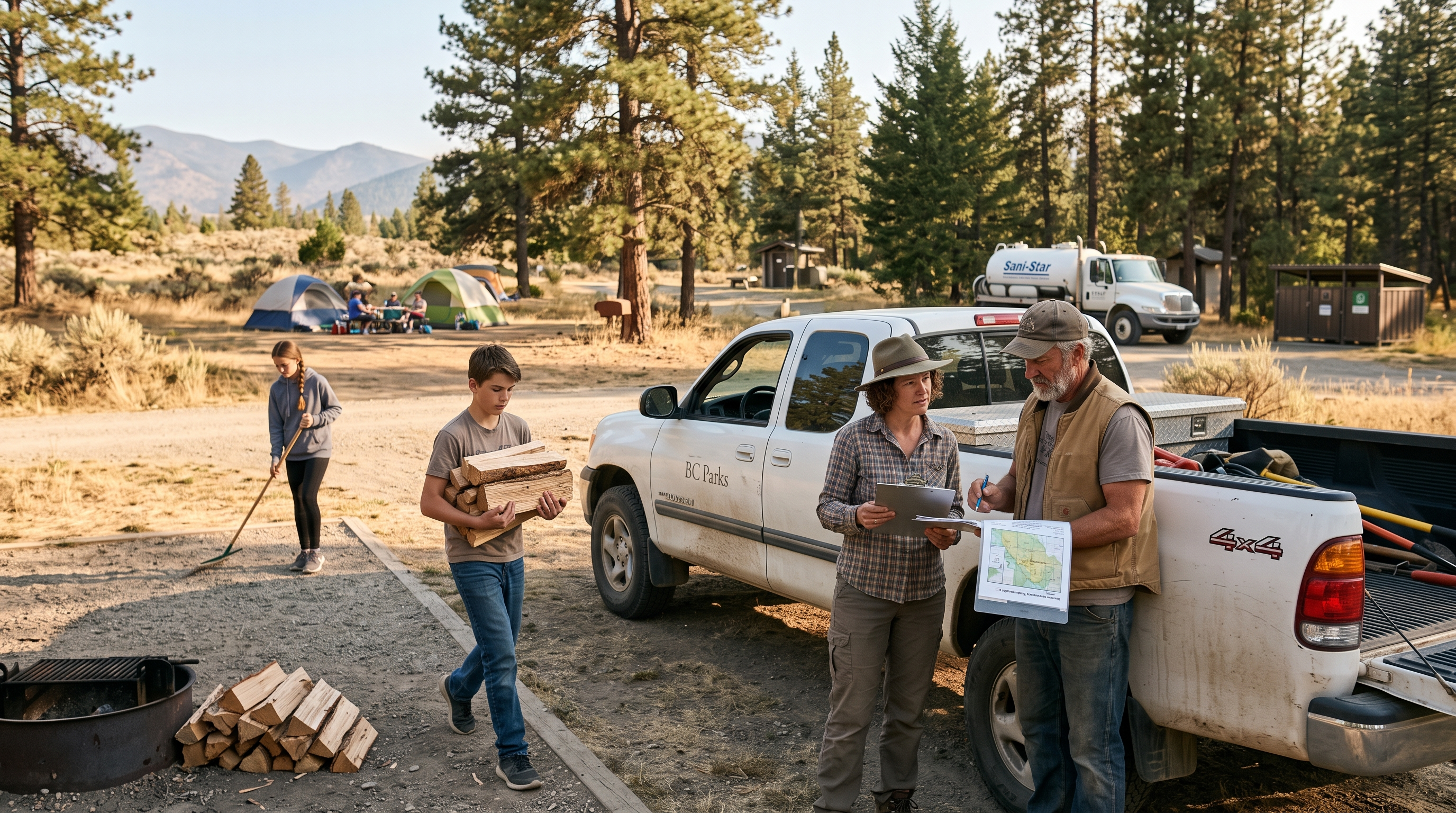
Moving into management changed the job from completing tasks to making sure the entire operation completed them.
How Work-Camping Compensation Really Works
According to the current Workamper News FAQ, compensation ranges from an RV site traded for a set number of hours to wages for every hour plus a campsite, utilities and other benefits. That range is precisely why you should never evaluate a position by the phrase “free site.”
| Compensation model | What to calculate | What to question |
|---|---|---|
| RV site only | Realistic monthly site value divided by required labour hours | Are utilities included? Is electricity metered? What happens when extra hours are needed? |
| Site plus wages after trade hours | Value of the site, unpaid trade hours and paid hourly rate | Are both members of a couple required to contribute hours? When does paid time begin? |
| Wages plus included site | Hourly earnings plus the amount you genuinely save on accommodation | Is the site a taxable benefit? Are utilities, laundry, internet or propane included? |
| Management salary or contract | Total compensation divided by realistic total hours and responsibility | Who carries insurance, payroll, maintenance costs and after-hours responsibility? |
A Simple Site-Value Test
Suppose a seasonal employee site is realistically worth $700 per month and the employer requires 60 hours of labour for it. The equivalent value is about $11.67 per hour before considering electricity, taxes, travel costs or the restrictions of living at work. If two adults must each provide 60 hours, the equivalent drops to about $5.83 per combined labour hour.
Use the campground’s monthly or seasonal rate for a comparable site, not its most expensive holiday-weekend nightly rate. Then ask whether you would have paid for that particular location if the job were not attached. A remote employee site beside a maintenance compound may be useful, but it is not automatically worth the same as the waterfront pull-through sold to guests.
Can a Family Work Camp Together?
Yes, but it requires a more specific conversation than “families welcome.” At Seymour, Jessica and I were the employees while our daughters followed their own routines. At Kentucky-Alleyne, we were able to hire them. That gave our family a shared project and gave the girls real experience with responsibility, schedules, guests and earning their own money.
The greatest benefit of all four seasons was that we worked together, lived together and learned from each other. Very few traditional jobs allow a family to see how each person handles pressure, solves problems and develops confidence. The hard part was that our private family space was also attached to the public-facing operation.
Do not assume another employer can make the same arrangement. CoolWorks notes that family housing is uncommon in many seasonal jobs, RV sites may be limited, and some employers require both adults occupying a supplied site to be employees. Confirm childcare, schooling, site occupancy, minimum working age, insurance and exactly who is covered by the employment agreement.
Why It Worked for Us
- We already lived full-time in our trailer.
- We were comfortable solving practical problems.
- Our family could adapt to remote and seasonal living.
- We treated the campground as a shared responsibility.
What Families Must Resolve
- Whether children can live or work onsite
- Privacy and personal space inside the RV
- Reliable internet, transportation and schooling
- What everyone does when the adults are both working
Related firsthand guide: Full-Time RV Living With Kids: What Actually Works for Family Life on the Road.
When Wildfire Ends the Plan Before You Are Ready
Seasonal workers talk about start dates and end dates as if both belong to the calendar. Nature occasionally has a different contract.
During our second season at Seymour, the Scotch Creek fires changed everything. We were under evacuation pressure, the operating season was shut down approximately a month early, and the ending did not arrive with a final shift, staff supper or clean handoff. We learned two days later that the day we had already worked had been our last.
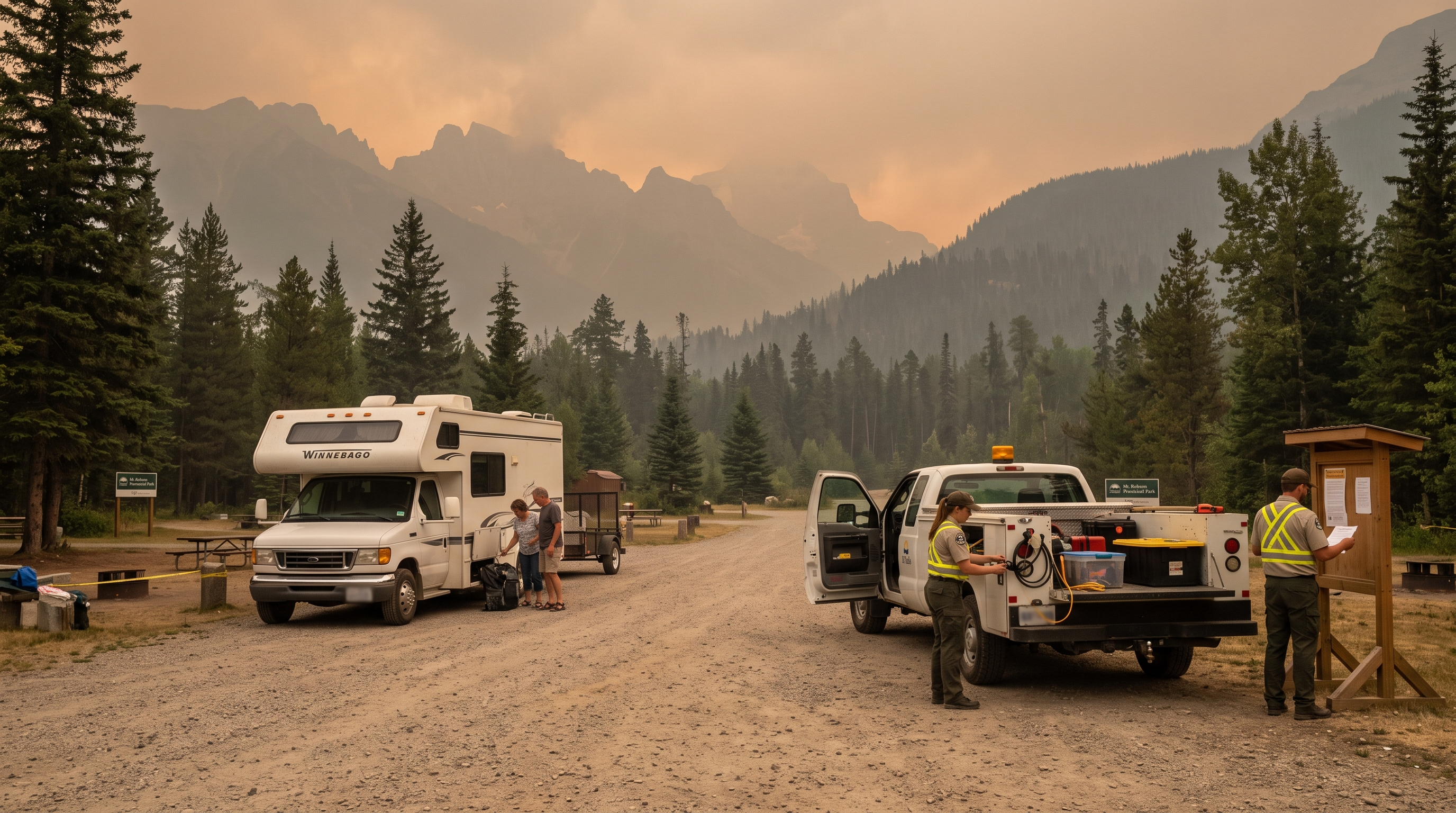
A seasonal position can end because of wildfire, flooding, smoke, closure orders or another event nobody could schedule.
At Kentucky-Alleyne, nearby fires started during our fourth season, but crews contained them before they developed into the same kind of disruption. Both experiences reinforced the same point: your home, income and workplace can all be affected by one emergency.
The Best and Hardest Parts of Living Where You Work
What We Gained
- Four seasons spent working as a family instead of living separate daily lives
- A campsite and seasonal base in remarkable parts of British Columbia
- Practical management, maintenance and customer-service experience
- Relationships with returning campers, staff and nearby communities
- Stories and lessons that followed us long after the gates closed
What It Cost
- Days off that never felt completely protected
- After-hours requests because campers knew where we lived
- Family privacy inside an active public operation
- Seasonal income exposed to closures and emergencies
- The emotional load of being responsible while trying to relax
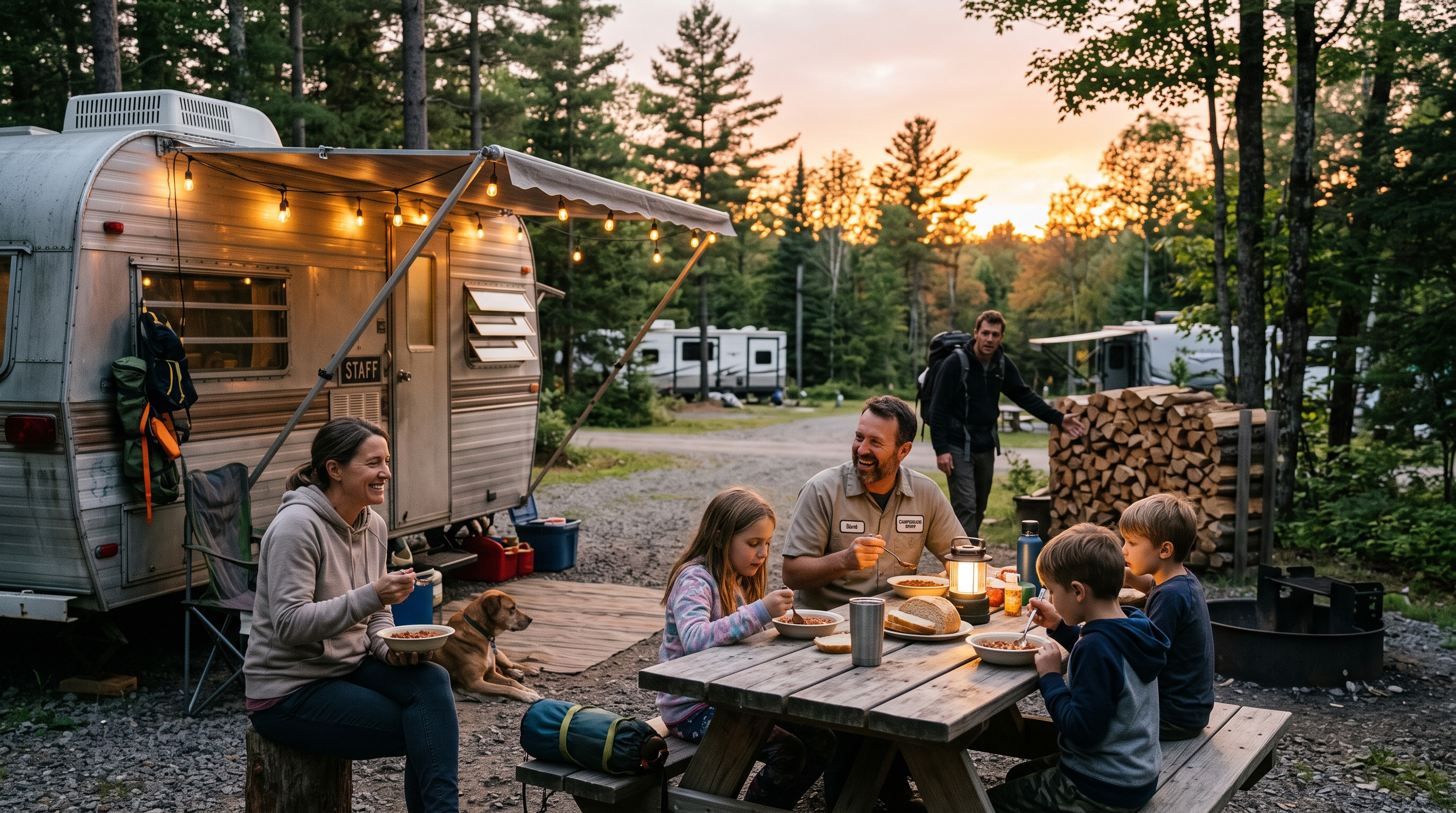
Shade, supper and family time can still be interrupted by a camper looking for firewood after hours.

The Stories That Never Make the Campground Brochure
Four seasons left us with considerably more than a line on a resume. They gave us strange encounters, difficult days, memorable campers, management lessons and stories that could only happen when your workplace and home occupy the same campsite.
I collected the fuller story in Under the Picnic Table: Tales of a Park Operator. The book is not a training manual or an official account from BC Parks. It is our family’s experience of operating campgrounds, told from beneath the trees, beside the firepits and occasionally from under the picnic table.
Affiliate disclosure: As an Amazon Associate, I may earn from qualifying purchases at no additional cost to you. I am also the author of this book.
How to Evaluate a Work-Camping Job Before Saying Yes
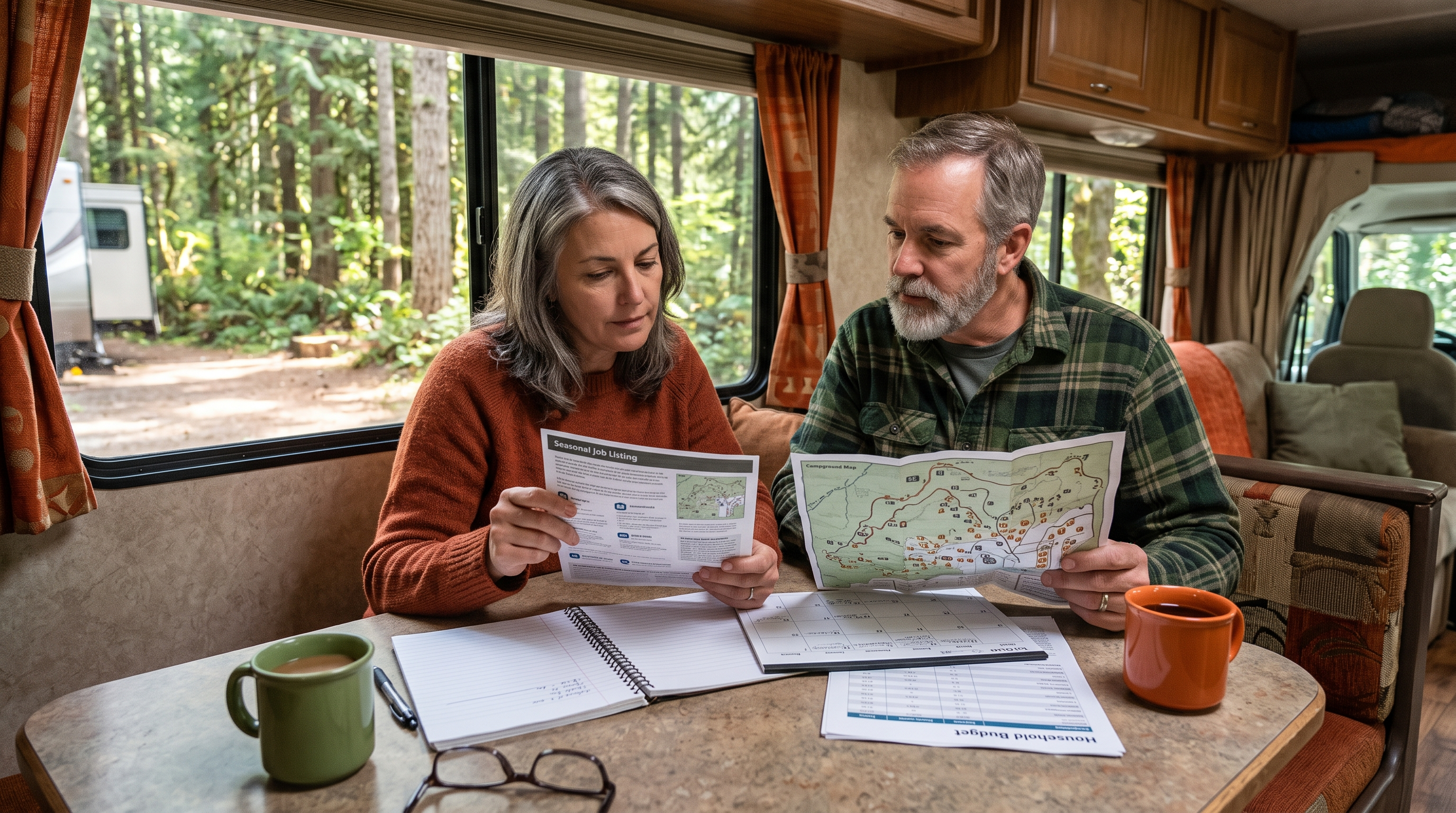
A beautiful location is one line in the decision, not the entire decision.
Compensation Questions
- Are all hours paid, or are some traded for the RV site?
- What value is assigned to the site, and how was it calculated?
- Are electricity, water, sewer, laundry and internet included?
- Are deposits or site deductions taken from each paycheque?
- How are overtime, emergency callouts and statutory holidays handled?
Lifestyle Questions
- How many consecutive days off are protected?
- Who responds after hours?
- Can family members and pets occupy the employee site?
- How far away are groceries, fuel, healthcare and repairs?
- Is cell service or internet reliable enough for your needs?
Job-Scope Questions
- How many sites, loops or separate parks are involved?
- Who cleans washrooms and handles garbage?
- Will you collect money or enforce park rules?
- Are maintenance tools, training and protective equipment supplied?
- Will you supervise, hire or dismiss other employees?
Exit and Emergency Questions
- What happens if wildfire, flooding or smoke closes the campground?
- How quickly must the employee site be vacated?
- What happens if either party ends the arrangement early?
- Who covers workplace injuries and vehicle or RV damage?
- Can you speak with a previous seasonal employee?
Where to Find Legitimate Work-Camping Opportunities
We found our original position through Indeed. Today, I would use several sources and compare the opportunity against the actual operator or employer website before applying.
- British Columbia park work: the BC Parks park-operator page explains the contractor system and points job seekers toward current operator employment resources.
- Workamping-specific listings: Workamper News focuses on opportunities for RVers, particularly in the United States.
- Seasonal destination work: CoolWorks lists jobs at parks, resorts, ranches and other seasonal destinations. Housing and RV-site availability differ.
- General job boards: Indeed and regional employment sites can surface contractor, resort and campground positions that never use the word “workamping.”
- Direct contact: identify the company operating a campground and check its employment page. Some seasonal teams recruit before public listings receive much attention.
Who Work Camping Is—and Is Not—For
It May Fit You If…
- You genuinely enjoy helping the public.
- You can switch between quiet routines and sudden problems.
- You are comfortable living close to coworkers and guests.
- You can handle cleaning, maintenance or rule enforcement without romanticizing the job.
- The total compensation works after you calculate the real hours.
Think Twice If…
- You require firm separation between home and work.
- You are accepting mainly because the destination photographs look good.
- The employer will not put duties or compensation in writing.
- Your budget cannot survive a delayed opening or early closure.
- You dislike cleaning, conflict or being interrupted.
Our Final Verdict After Four Seasons
Work camping gave our family an unconventional education. We learned how campgrounds operate, how people behave when rules interfere with their weekend, how quickly nature can change a business plan and how much a family can accomplish when everyone contributes.
It also taught us that freedom and availability are not the same thing. We lived in beautiful places, but we were responsible for those places. Even when the active work was finished, the campground was still outside our door.
Would we do it again? We already did—four times. That is the honest answer. But we would never again judge an opportunity by scenery, a free campsite or a vague promise of “light duties.” We would calculate the hours, clarify the boundaries, prepare for an early ending and make sure the arrangement worked for the whole family.
If the numbers and expectations hold up, work camping can be far more than a seasonal job. It can become a chapter of your life that your family talks about for years. Just remember: somebody still has to clean the firepit after the brochure photo is taken.
Frequently Asked Questions About Work Camping
What is the difference between work camping and workamping?
They are commonly used to describe the same lifestyle: working while living or travelling in an RV. Workamper News uses “Workamper” for individuals, couples and families who combine RV camping with paid work, volunteering, a business or another exchange of labour for value.
Do work campers always receive a free campsite?
No. Some receive a site in exchange for labour, some receive wages plus a site, and others earn wages while arranging their own accommodation. Always confirm whether the site is included, deducted, taxable or tied to a required number of hours.
How many hours a week do work campers work?
It depends entirely on the position. Light hosting exchanges may require limited weekly hours, while paid operational and management jobs can approach or exceed full-time hours. Ask how after-hours interruptions and emergency responses are recorded.
Can families with children become work campers?
Yes, but not every employer or supplied RV site allows the same arrangement. Confirm who can occupy the site, whether both adults must work, whether children can be employed legally and how schooling, childcare and insurance will work.
Are campground hosts government employees?
Not necessarily. In British Columbia, many park facilities are managed by private contractors called park operators. Employees may work for the operating company rather than directly for BC Parks. Volunteer host programs may use a different structure.
Is work camping worth it financially?
It can be, but only after comparing all wages and benefits with the real hours, site value, travel costs and loss of privacy. A “free” campsite may be poor compensation if too many unpaid hours are required.
Where can Canadians find park-operator jobs?
Start with the BC Parks park-operator information page, the employment resources it identifies, general job boards such as Indeed and the career pages of companies contracted to operate parks. Hiring methods and openings change by season.
Sources and Editorial Notes
- BC Parks: Park Operators
- Province of British Columbia: Employment Standards
- Workamper News: What Is Workamping?
- Workamper News FAQ: Jobs and Compensation
- CoolWorks: Seasonal Work With a Family
Firsthand material comes from Jeremy and Jessica Denesovych’s four seasons operating campgrounds in British Columbia and from Jeremy’s book, Under the Picnic Table: Tales of a Park Operator. Employer names and identifying details about individual campers have intentionally been omitted. This article is educational and does not provide legal, tax or employment advice. AI-generated article images are illustrative recreations and do not depict the actual people or incidents described.


Leave a Reply