

Last Updated on November 7, 2026 by Jeremy
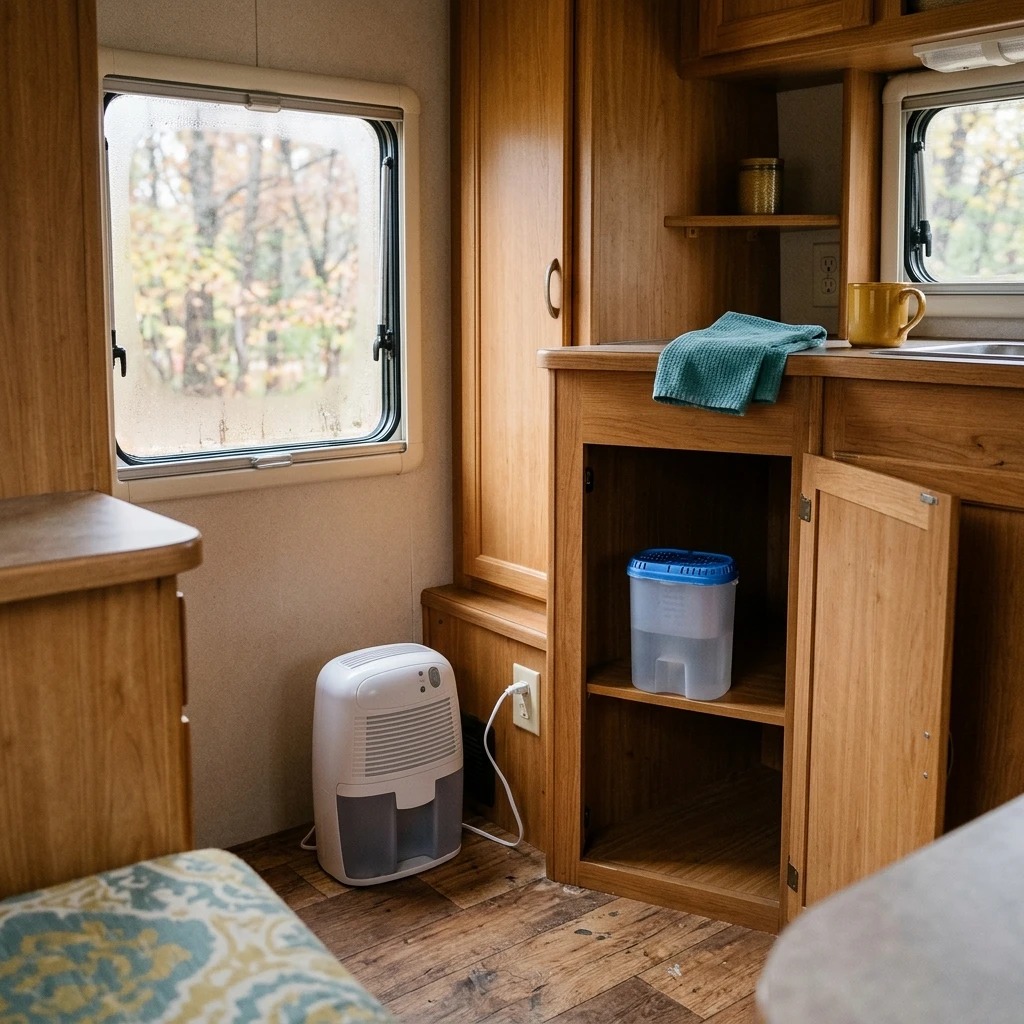
A tub of moisture absorber in the cupboard and a plug-in dehumidifier beside the dinette can both collect water. That does not make them interchangeable. The right choice depends on whether you are living in the trailer, storing it, plugged into shore power or trying to stretch your batteries.
Quick answer: For an occupied RV with persistent humidity and suitable electrical power, an electric dehumidifier offers active moisture removal. A disposable moisture absorber is a useful option for a small enclosed area or a stored RV without power, provided you inspect and replace it as directed. Neither repairs a roof leak, replaces required ventilation or guarantees a dry trailer.
This is a comparison of approaches, not a new product ranking. Our small-dehumidifier article contains the older product shortlist and my experience with a KoolKing unit. The guidance here draws on manufacturer instructions and moisture-control references, rather than claiming we tested every type side by side.
RV dehumidifier vs moisture absorber: the practical differences
| Decision | Electric dehumidifier | Disposable moisture absorber |
|---|---|---|
| Where it fits | Occupied, heated RV with persistent moisture and a suitable power supply | Closets, cabinets and storage situations where a non-electric product is useful |
| What you maintain | Collection bucket or approved drain, filter, airflow and electrical supply | Crystals or refill, collection container and secure placement |
| Control | Many units offer a humidity setting; check the individual model | Passive absorption; no powered fan or adjustable humidistat on a basic tub |
| Off-grid cost | Consumes energy that must fit your battery and charging plan | No operating electricity, but ongoing replacement cost |
| Cold-weather question | Must operate within the model’s temperature limits | Performance and replacement interval depend on conditions; follow the label |
| What it cannot do | Repair leaks or dry hidden damage by itself | Absorb standing water or replace a leak repair |
Start with a humidity reading and a leak check
Before buying anything, put a hygrometer where you actually live and sleep. Record relative humidity and temperature in the morning and again after cooking or showering. Check behind cushions, under the mattress and inside accessible cupboards for damp surfaces.
The EPA’s general indoor guidance is to stay below 60% relative humidity, ideally 30–50% where possible. An RV’s cold windows can still condense at those levels. Airstream notes that cold climates may require 35% or less to avoid window condensation. Treat those figures as guidance, then follow your RV manual and what the cold surfaces are doing.
If a wet patch appears after rain, follows a roof joint or keeps returning in one spot, investigate water entry. If windows and several cold surfaces become wet overnight, indoor condensation is a possible contributor. Both can happen together. A dry-looking window does not prove that the wall behind it is dry.
When an electric dehumidifier makes more sense
Cooking, showers, wet jackets and everyday occupancy keep adding moisture. If you have shore power and are emptying a collection bucket regularly, active removal may be a better fit than repeatedly replacing passive tubs.
Choose by the model’s operating conditions and actual removal specification, not just an advertised room size. The pint rating commonly describes moisture removal over a stated period and test condition; it is not automatically the capacity of the collection bucket. Read both specifications separately.
- Check temperature limits. Frigidaire’s troubleshooting guidance says its units will not operate satisfactorily below 5°C (41°F). That is manufacturer guidance for those units, not a universal limit for every design.
- Plan the electricity. Use the model’s rated input and allow for its operating cycle and inverter losses. For illustration, a 250-watt appliance running for four hours uses 1,000 watt-hours before losses. That is arithmetic, not a claim about a particular model.
- Plan the water. Empty the bucket before it stops the machine. Use continuous drainage only as the manual allows, with a secure route and a receiving drain that can accept it.
- Leave breathing room. Keep intake and discharge clear, and clean the filter at the instructed interval.
A small footprint is useful in a trailer. It does not prove the unit can keep up with your moisture load, and a larger tank does not automatically mean faster extraction.
When a moisture absorber earns its space
A non-electric absorber can be handy in a cupboard or a stored RV where electricity is unavailable. DampRid specifically markets products for stored RVs and campers. Its instructions also say the product removes moisture from the air, not standing water.
The trade-off is ongoing attention. Check the exact product’s instructions for replacement, refilling and disposal. DampRid’s disposable product guidance calls its protective cover spill-resistant rather than spill-proof. Place containers upright where they cannot tip, and keep them away from children and pets.
Do not assume a package that says “up to” a certain number of days will last that long in your trailer. Conditions change. A collection tub is not a substitute for checking on the RV during storage.
Three RV situations, three different decisions
You are living in the RV on shore power
Control moisture at its source first: use the appropriate exhaust ventilation while cooking and showering, and move wet gear out of the living area where practical. If humidity stays high, compare electric units that fit the temperature, available circuit and storage space. A passive tub may still help in a cupboard, but judge the overall result with readings rather than the amount of liquid in one container.
You are boondocking
Start with ventilation and moisture reduction, then work out whether active removal fits the energy budget. Keep manufacturer-required ventilation open. A tub that uses no electricity is convenient, but convenience alone does not establish adequate moisture control for an occupied trailer.
The RV is parked and unoccupied
Dry the interior before storage, fix known leaks and follow the RV manufacturer’s storage directions. An absorber may suit a no-power setup. A powered unit needs a suitable temperature, approved electrical arrangement, drainage plan and regular checks. Winterization still needs its own checklist; neither option protects plumbing from freezing.
What to do if the windows are still wet
Measure again, inspect cold corners and check whether the equipment is actually operating. A full bucket, blocked filter, low operating temperature or continuing water entry can leave you chasing the wrong problem. Our guide to RV heat loss and cold surfaces explains why framing, windows and airflow matter. For the broader seasonal routine, read Winter RV Living Tips.
Persistent musty smells, soft materials, recurring stains or dampness you cannot trace deserve further inspection. Adding another tub does not establish that the underlying problem is solved.
Turn the moisture problem into a maintenance task
Record the readings, the wet location and what changed. Keep the inspection and follow-up together so a temporary improvement does not become a forgotten repair.
Open the RV Maintenance TrackerQuestions RV owners ask
Can I use both?
Yes, where the instructions allow. They can serve different spaces. Keep checking overall humidity and damp surfaces rather than assuming two products provide complete protection.
Does collecting water mean the RV is dry?
No. It shows moisture reached that device. Hidden cavities, an isolated cabinet or a continuing leak may still be wet.
Should I buy from the square-foot rating alone?
No. Temperature, moisture load, ventilation, power draw, extraction conditions and drainage all affect whether the product fits your use.
Sources and further reading
- Airstream: managing moisture and moisture-related damage
- EPA: moisture and indoor humidity guidance
- Frigidaire: operating temperature and troubleshooting
- DampRid: use in RVs and campers
- DampRid: disposable product and spill guidance
Reviewed November 7, 2026. Follow your RV manual and the instructions for the exact equipment you choose.


Leave a Reply