

Last Updated on September 14, 2026 by Jeremy
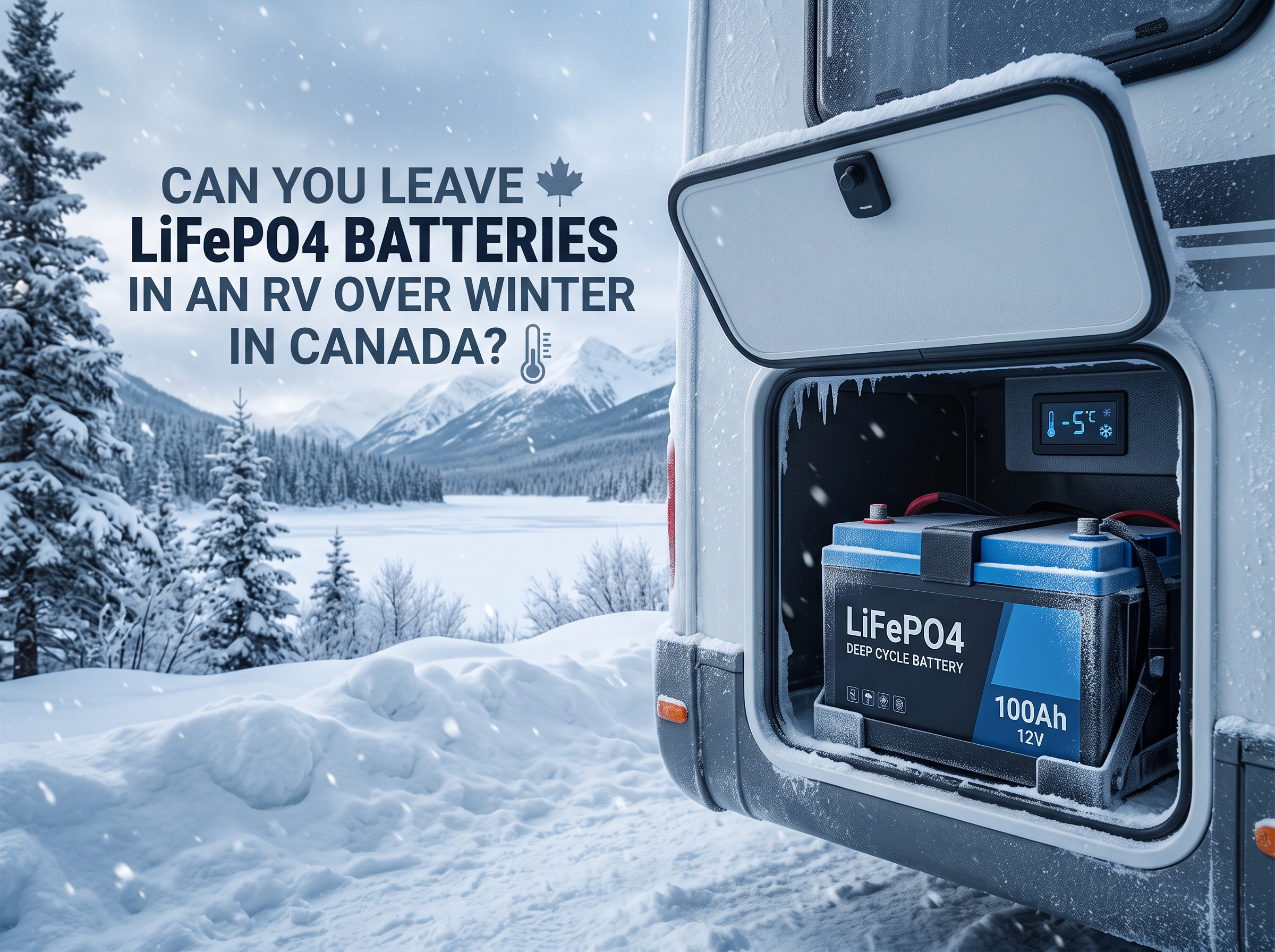
Leaving an RV battery outside for a Canadian winter sounds like a simple yes-or-no decision. With LiFePO4 batteries, however, the answer depends less on the snow around the trailer and more on the battery model, its internal temperature and whether anything can still charge or drain it.
In many cases, a healthy LiFePO4 battery can remain installed through winter. It must stay within the manufacturer’s storage-temperature range, be disconnected from parasitic loads and be protected from charging below its permitted temperature. If any of those conditions cannot be confirmed, bringing it into a dry, temperature-controlled space is the safer choice.
This guide focuses specifically on RV lithium battery winter storage in Canada. It does not replace the manual for your battery, charger, inverter or RV electrical system, because those specifications ultimately control the decision.
Cold Storage and Cold Charging Are Not the Same Thing
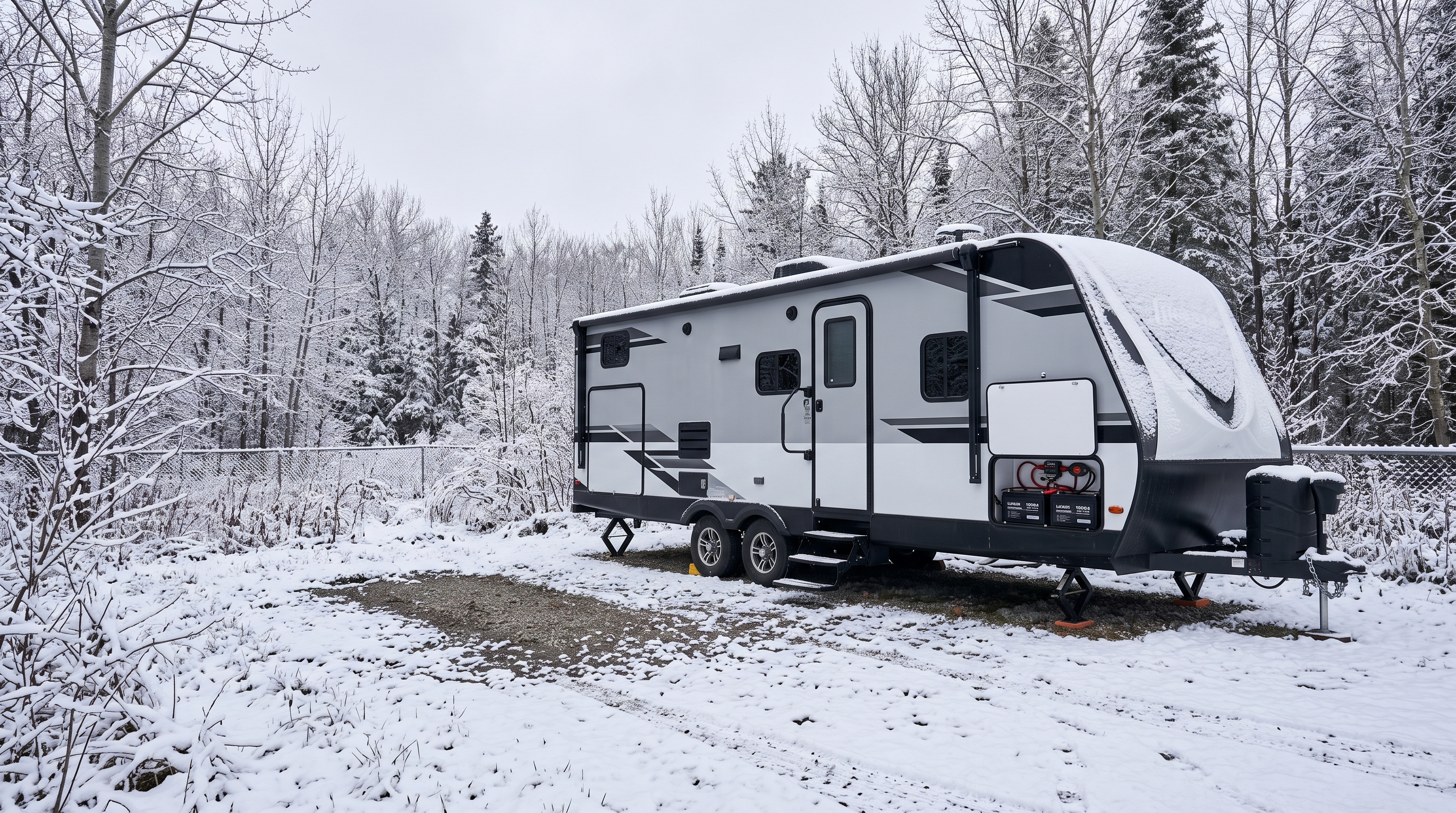
The most important distinction is between storage, discharging and charging. A battery may be permitted to sit or power loads below freezing while still being prohibited from accepting a charge at that temperature.
Charging a LiFePO4 battery when its cells are too cold can cause lithium plating inside the cells. That can permanently reduce capacity and may create a safety problem. This is why a sunny winter day can be more troublesome than it appears: snow may be sitting around the trailer while exposed solar panels begin sending current toward a frozen battery.
Some batteries contain a battery management system that blocks low-temperature charging. Others have self-heating, while some provide neither feature. Even the cutoff temperature varies. The label “LiFePO4” does not confirm what protection is actually inside your battery.
Manufacturer Instructions Differ More Than Most Generic Advice Suggests
There is no single winter-storage percentage or temperature that applies to every RV lithium battery. The examples below show why the exact manual matters.
| Manufacturer example | Published guidance | What it demonstrates |
|---|---|---|
| Battle Born | Storage range down to -15°F (about -26°C); above-freezing storage is preferred when possible. Its winterization guidance recommends storing its batteries fully charged, and its BMS blocks charging below an internal temperature of 24°F (about -4°C). | A battery can have a cold storage rating that is much lower than its charging cutoff. |
| Victron Lithium Battery Smart | Discharging is permitted from -20°C to 50°C, while charging is permitted from 5°C to 50°C. | Even a battery that can discharge below freezing may need to be warmer before charging. |
| Redodo | Its long-term storage guidance recommends approximately 40% to 50% state of charge and a moderate storage environment. | State-of-charge recommendations vary by brand; 40% to 60% is not a universal rule. |
Practical rule: use the storage temperature, charging temperature and state-of-charge instructions for your exact model. Do not substitute a number from another brand simply because both batteries use LiFePO4 chemistry.
When You Can Usually Leave the Battery Installed
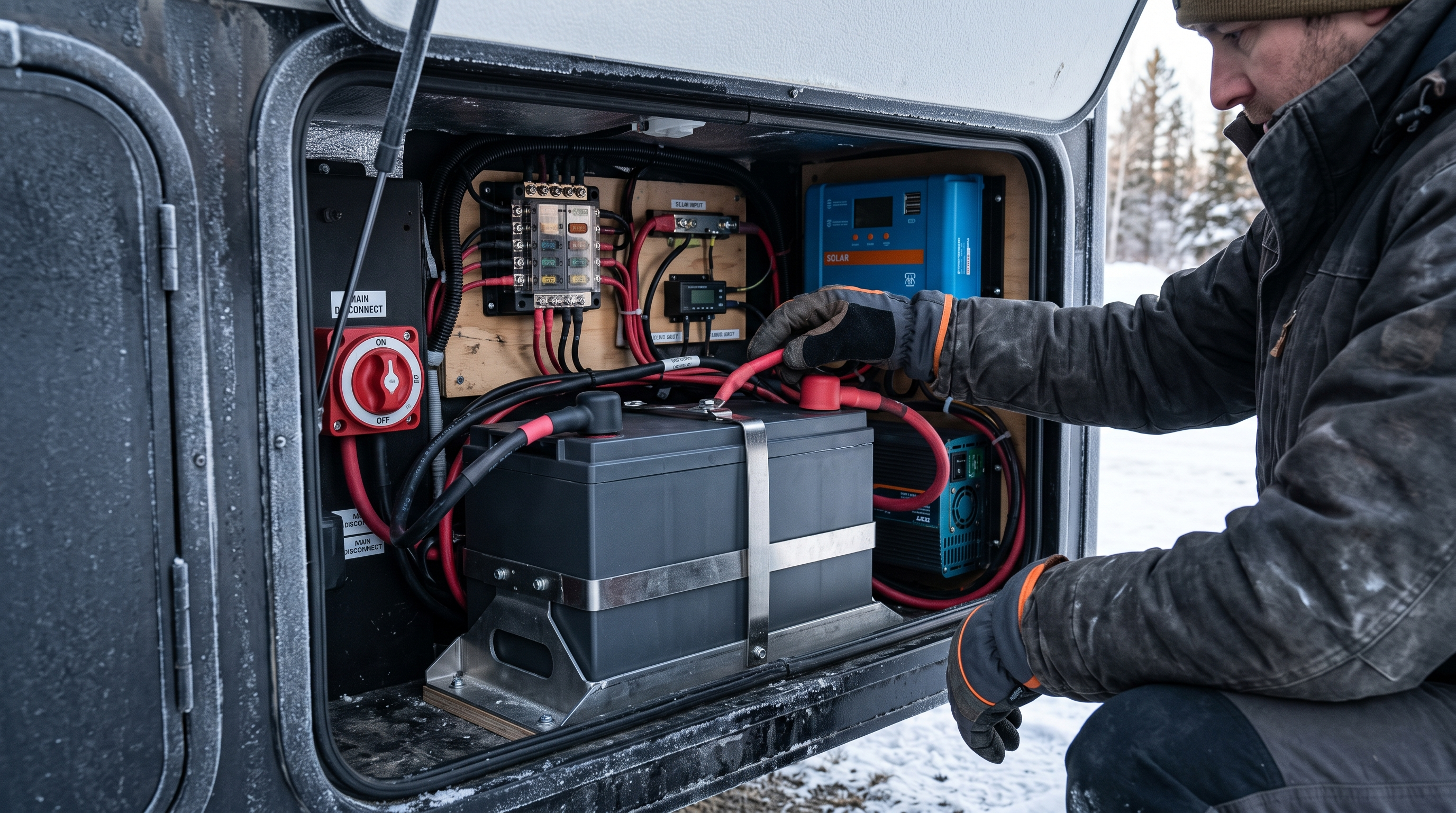
Leaving the battery in the RV is generally reasonable when all of the following statements are true:
- You have identified the exact battery model and read its current manual.
- The coldest temperature expected inside the battery compartment remains within its published storage range.
- The battery begins storage at the manufacturer’s recommended state of charge.
- Parasitic loads such as detectors, stereo memory, monitoring modules and inverter standby draw are genuinely disconnected.
- Shore power, the converter/charger, solar charging and alternator or DC-to-DC charging are isolated as required.
- Any low-temperature cutoff or heating feature has been verified for that model rather than assumed.
- The compartment is dry, protected from physical damage and accessible for periodic checks.
A battery disconnect switch helps, but it does not prove that every device has been isolated. Some RVs have equipment wired directly to the battery side of the switch. A clamp meter, system diagram or qualified technician can help confirm whether current is still leaving the battery.
When Bringing It Indoors Is the Better Decision
Remove the battery when the winter setup contains too many unknowns. Indoor storage is usually the more conservative choice if:
- Local temperatures may drop below the battery’s published storage minimum.
- The battery model or its low-temperature protection cannot be verified.
- Solar or another charging source cannot be confidently shut down.
- Parasitic loads remain after the RV’s disconnect is switched off.
- The compartment is exposed to water intrusion, road spray or physical damage.
- The battery is already at a very low state of charge.
- The manufacturer recommends an above-freezing storage environment.
Canadian weather also varies enormously. A sheltered compartment during a mild coastal winter is not the same storage environment as an exposed battery box during a Prairie cold snap. Use the temperature at the battery—not a seasonal average or the forecast for the nearest airport.
How to Store a LiFePO4 Battery in the RV
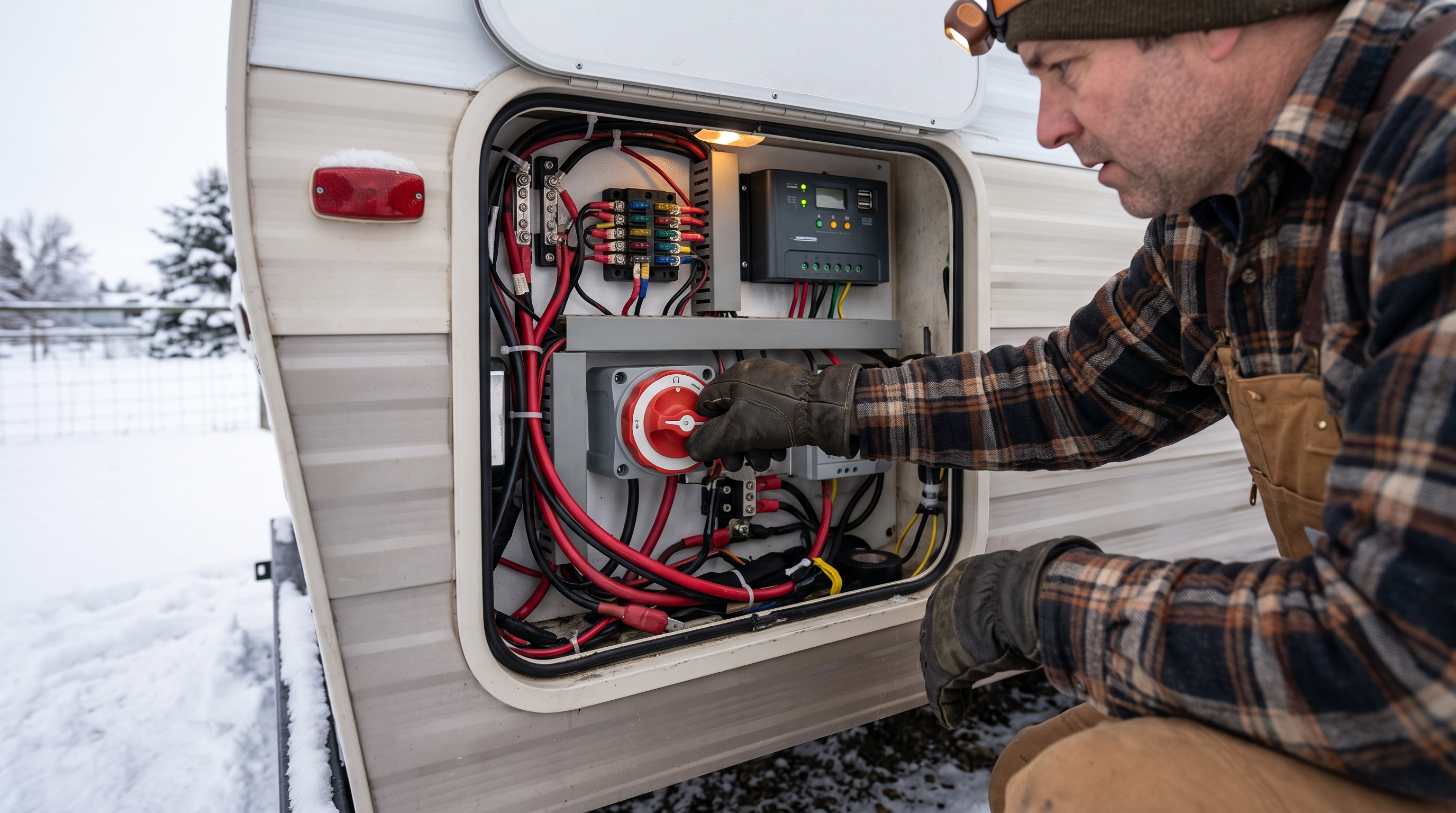
- Identify every component. Record the battery model, BMS features, charger, converter, inverter, solar controller and DC-to-DC charger.
- Read the battery’s storage instructions. Confirm its storage range, recommended state of charge, inspection interval and minimum charging temperature.
- Set the correct state of charge. Use the battery manufacturer’s number, not a generic internet percentage.
- Shut down loads correctly. Follow the RV and component manuals before operating battery disconnects or removing cables.
- Control every charging source. A converter, solar array or alternator connection can each create a charging path.
- Protect exposed terminals. Prevent tools, stored gear or loose metal objects from bridging the terminals.
- Record the starting condition. Note voltage, indicated state of charge and storage date in your maintenance log.
- Check it periodically. Follow the manufacturer’s interval and investigate unexpected loss rather than repeatedly topping it up without finding the draw.
How to Store the Battery Indoors
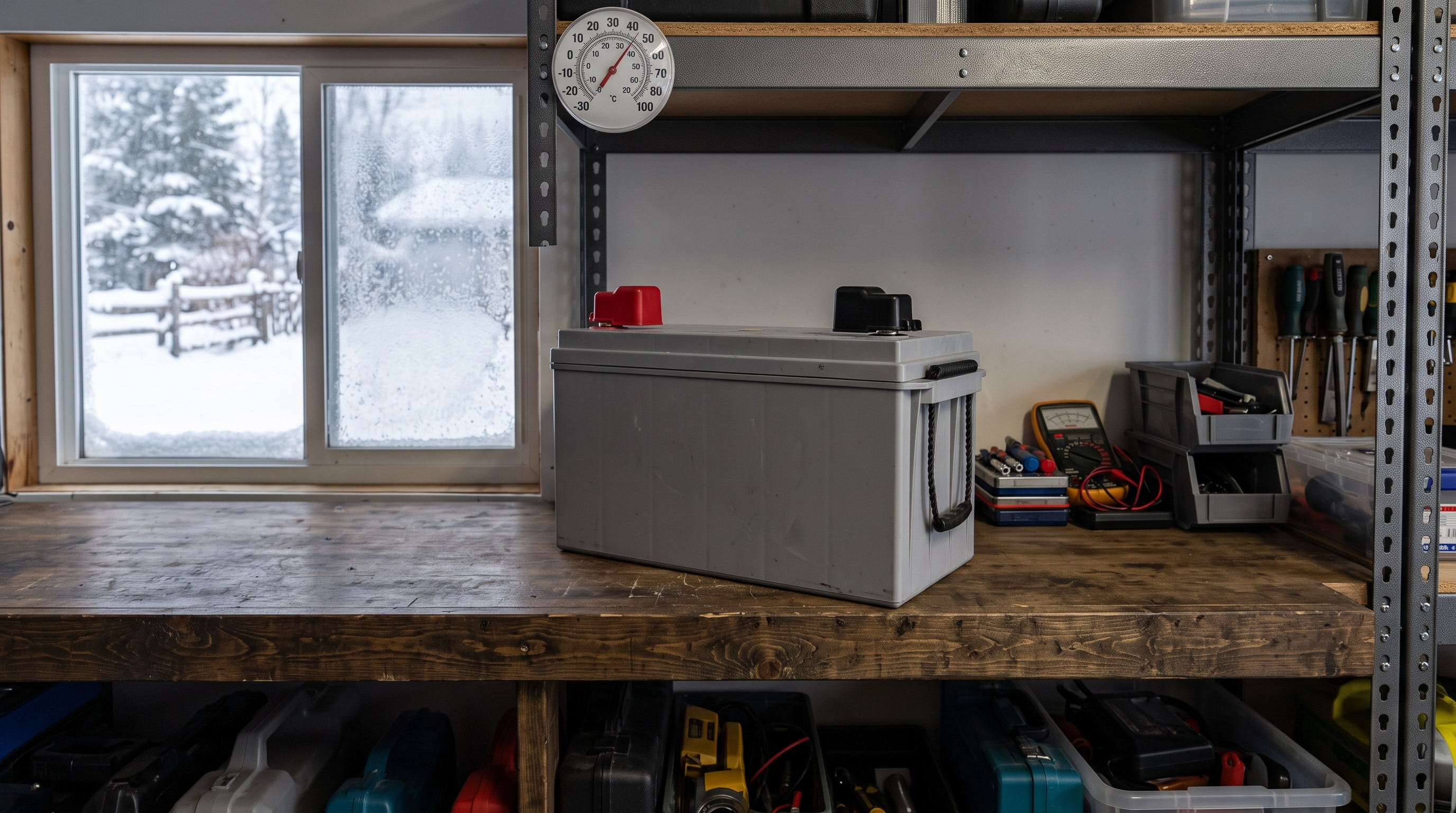
Choose a dry, secure location within the battery’s published storage-temperature range. Protect the terminals, keep the battery upright unless its manufacturer permits another orientation, and keep it away from children, impact hazards and conductive objects.
A modern sealed battery does not lose charge simply because it is sitting on concrete. The practical concerns are moisture, contamination, temperature, physical protection and unintended electrical connections. A sturdy shelf or non-conductive tray can still be useful, but not because concrete magically drains the battery.
Do not attach a generic battery tender by default. Confirm that the charger has a manufacturer-approved lithium profile and that charging will occur only within the battery’s permitted temperature range. Many LiFePO4 batteries have low self-discharge and are better stored disconnected with periodic checks than continuously maintained by an unsuitable charger.
What About Self-Heating Lithium Batteries?
A self-heating battery can make cold-weather use easier, but it does not eliminate planning. The heater needs energy, may activate only under certain charging conditions and can gradually reduce stored capacity if it cycles while the RV is unattended.
Confirm the heater’s activation logic, cutoff points and energy source. A heated battery should still remain within its published storage range, and its charging system must still follow the manufacturer’s instructions.
Spring Reconnection Checklist
- Inspect the case for cracks, swelling, impact damage or water intrusion.
- Check terminals, lugs, cables, fuses and disconnects for looseness, corrosion or heat damage.
- Allow the battery to warm above its minimum charging temperature before charging.
- Confirm voltage and state of charge using the manufacturer’s approved method.
- Verify that all chargers still use the correct lithium settings.
- Reconnect the system in the sequence required by the RV and component manuals.
- Restore one charging source at a time and watch for abnormal voltage, heat, smell or BMS warnings.
Common Winter Storage Mistakes
- Assuming every lithium BMS has cold-charging protection.
- Leaving solar connected because shore power is unplugged.
- Using one storage percentage for every LiFePO4 brand.
- Leaving detectors or inverter standby loads connected for months.
- Trying to charge a frozen battery immediately after bringing it indoors.
- Using a lead-acid maintainer without explicit lithium compatibility.
- Ignoring a battery that has entered low-voltage protection.
Your Practical Next Step
If you are unsure which component is still drawing power or why the battery will not accept a charge, start with the RV System Troubleshooter. It helps narrow battery, converter, inverter and solar symptoms before parts are purchased.
Once the system and temperature requirements are clear, the Redodo Power brand guide provides an organized starting point for comparing lithium battery features. Some brand pages contain affiliate links that may earn us a commission at no additional cost to you.
You can also schedule winter checks in the RV Maintenance Tracker and review charging-system capacity with the RV Solar System Builder.
Safety Boundary
Stop and contact the battery manufacturer or a qualified RV electrical technician if the case is swollen, cracked, leaking, unusually hot or water-damaged, or if cables show melting or burned insulation. Do not improvise a recovery charge after a low-voltage shutdown. Follow the exact manual and keep metal jewellery and uninsulated tools away from battery terminals.
Sources
- Battle Born Batteries: How to Winterize and Store LiFePO4 Batteries
- Victron Energy: Lithium Battery Smart Operating Conditions
- Redodo: RV Battery Winter Storage
Frequently Asked Questions
Can LiFePO4 batteries freeze in an RV?
The battery can become colder than freezing, but whether it may be stored, discharged or charged at that temperature depends on its exact model. Those three temperature ranges are often different.
Can I leave my RV solar panels connected all winter?
Only if the battery and solar-controller manufacturers approve the configuration and the system reliably prevents charging below the battery’s minimum temperature. Otherwise, isolate solar using the approved shutdown procedure.
Should an RV lithium battery be stored fully charged?
Not universally. Battle Born recommends fully charged storage for its batteries, while other manufacturers recommend a partial state of charge. Follow the instructions for your exact battery.
Does every lithium battery BMS prevent charging below freezing?
No. Low-temperature protection, cutoff temperature and heating features vary by model. Verify the specification instead of assuming the BMS provides it.
Should I use a battery tender on a LiFePO4 battery?
Use one only when the battery manufacturer approves the charger and its lithium profile, and when charging can remain within the permitted temperature range. A generic lead-acid maintainer may be unsuitable.
How warm must the battery be before spring charging?
Warm it above the minimum charging temperature stated in its manual. That threshold varies; for example, Victron Lithium Battery Smart specifies a minimum charging temperature of 5°C.


Leave a Reply