

Last Updated on September 19, 2026 by Jeremy
A combination carbon monoxide and propane alarm is one of those RV components most people ignore until it wakes the entire trailer—or starts chirping because its service life is over. We have lived with a Safe‑T‑Alert dual alarm in our own travel-trailer life, including those unpleasant middle-of-the-night activations that send everyone scrambling.
This updated Safe‑T‑Alert 25‑742 review separates our firsthand experience from the current manufacturer specifications. More importantly, it corrects the old version of this article: the 25‑742 is still sold, its body is smaller than previously stated, and an unexplained alarm should never be casually labelled false before carbon monoxide and propane have been ruled out.
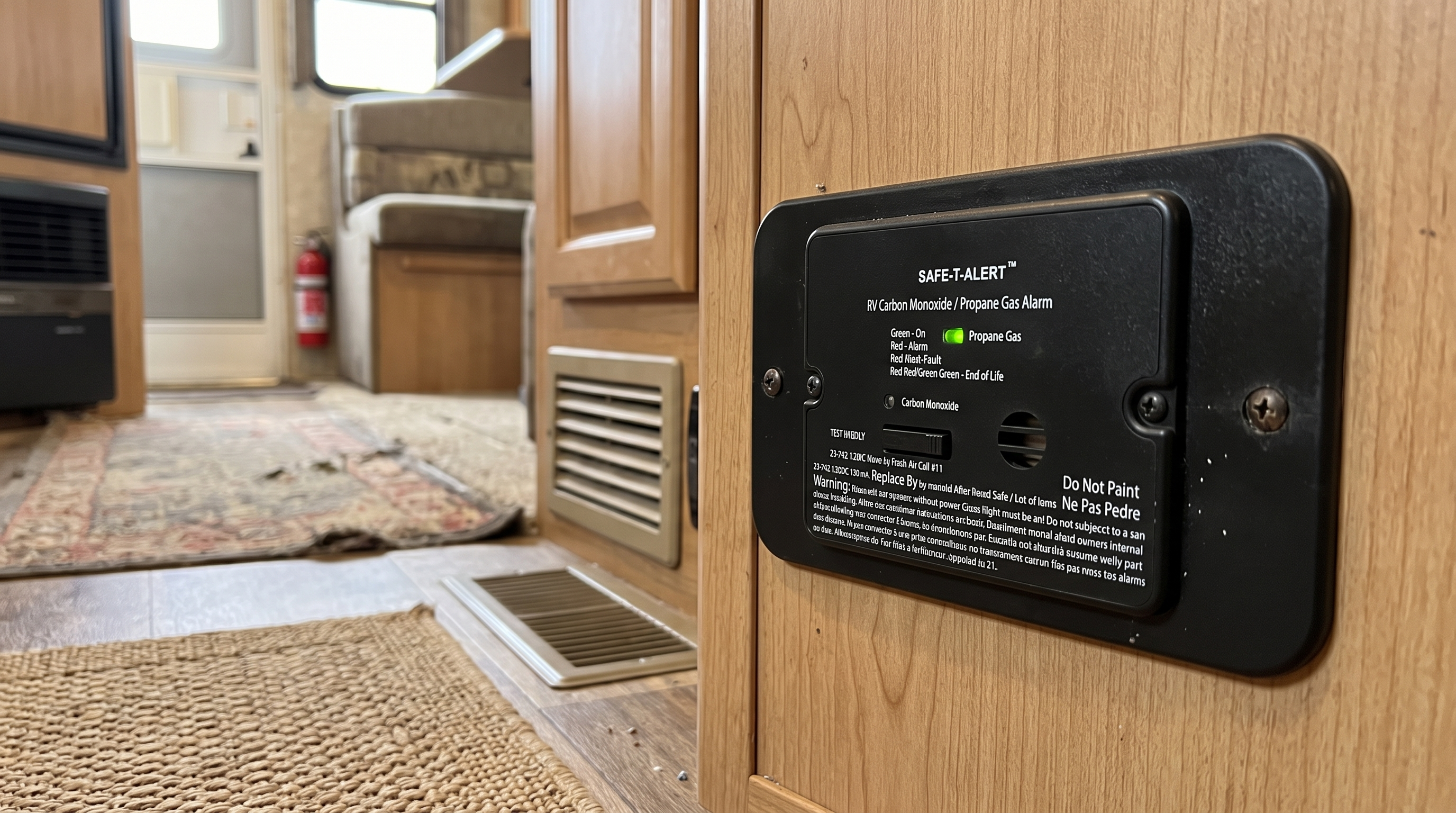
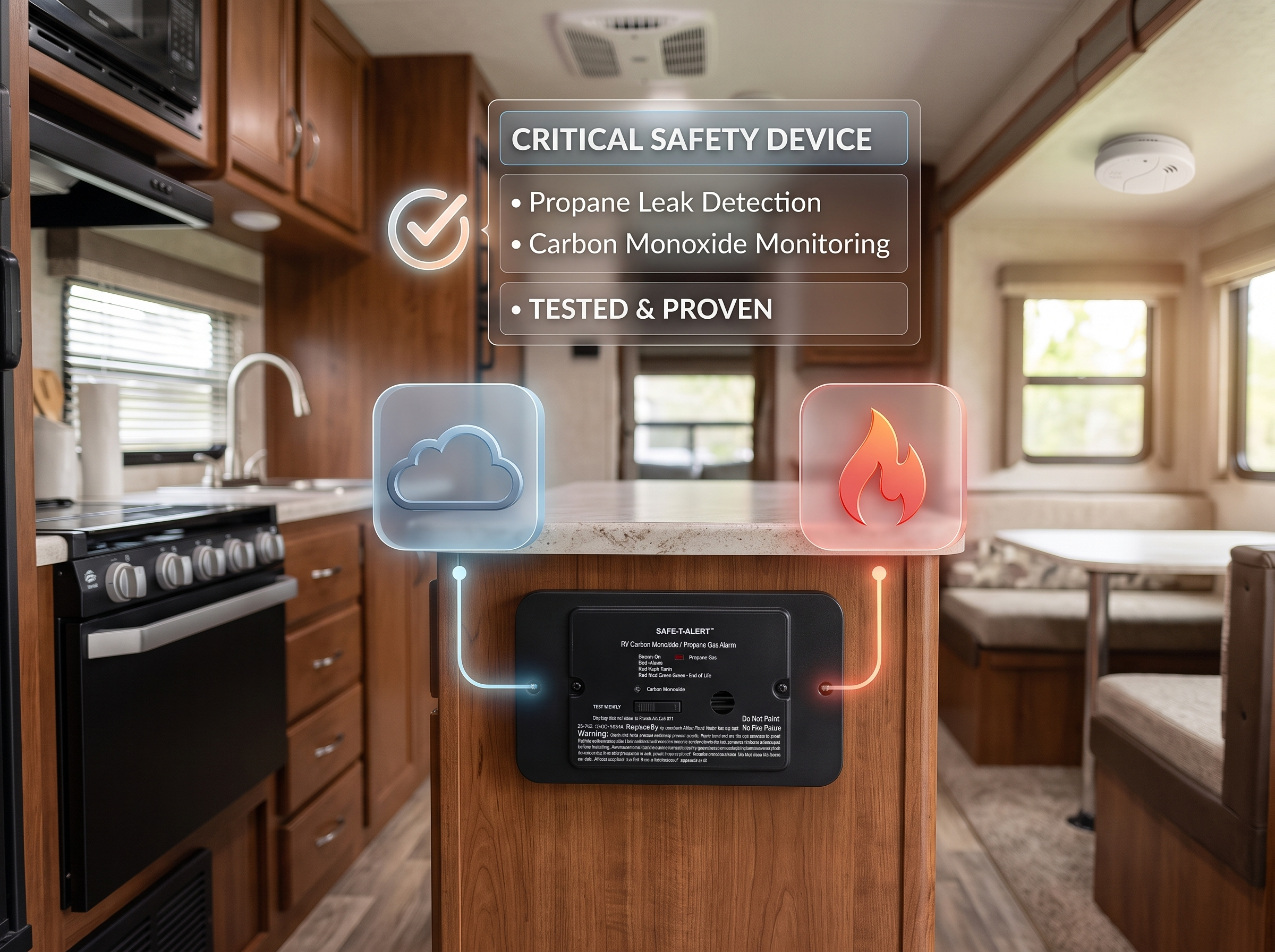
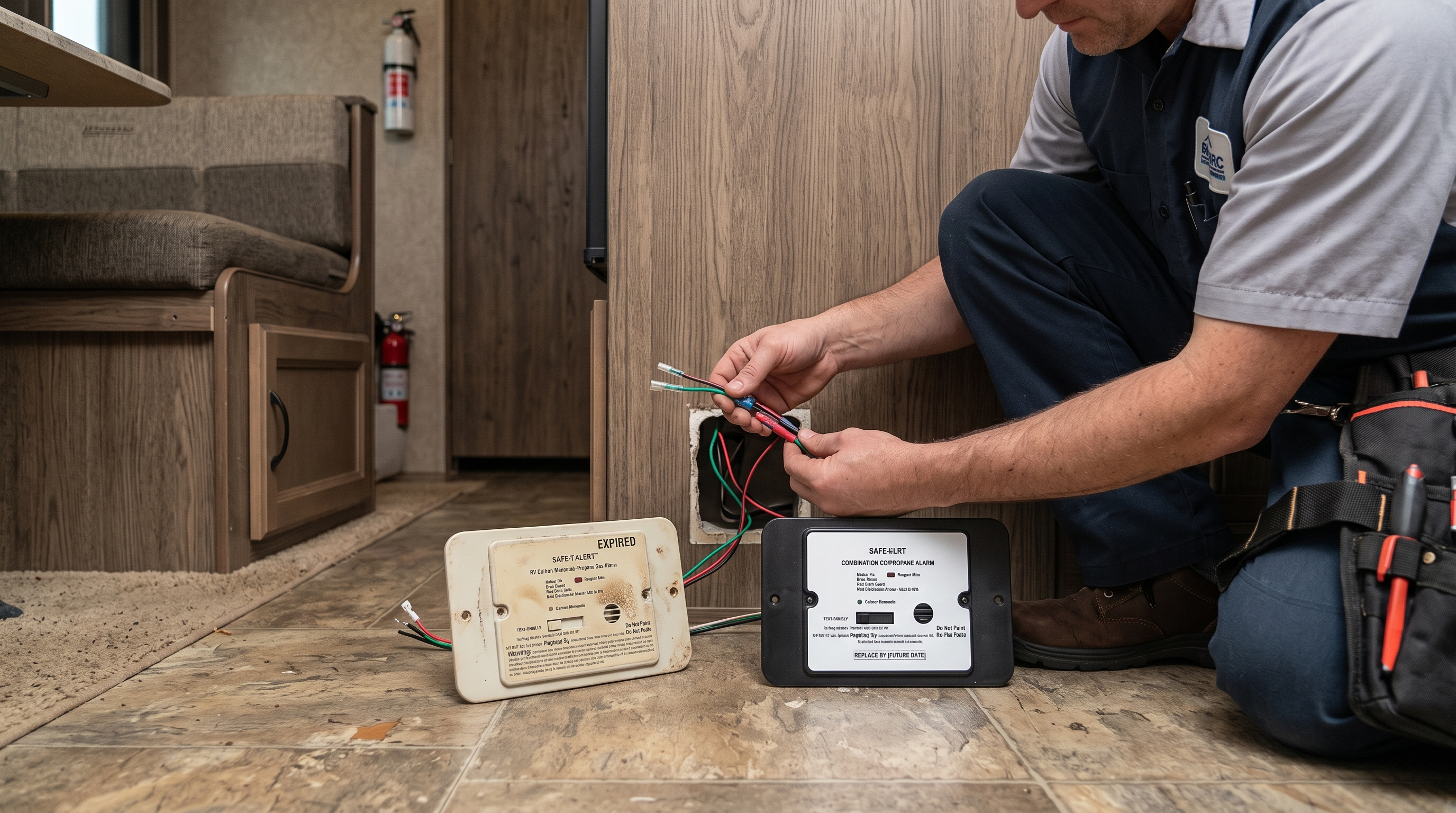
Image transparency: The product photograph was AI-cleaned from an original image, and the three supporting editorial illustrations were generated with AI. Product specifications come from Safe‑T‑Alert, not from the generated visuals.
Safe‑T‑Alert 25‑742 at a glance
- Product
- 25 Series flush-mount dual CO/LP alarm
- Model
- 25‑742
- Power
- 12 VDC hardwired, 108 mA nominal draw
- Service life
- Five years
- Case
- 4.5 in W × 3.25 in H × 1.25 in D
- Listings
- Conforms to UL 2034 RV and UL 1484 RV
- Warranty
- One-year limited warranty for the original retail purchaser
- Price checked
- US$123.20 on September 19, 2026
Our verdict
A strong direct replacement when the opening, wiring and mounting location fit. It provides two essential RV warnings in one compact unit without replaceable batteries.
Its tradeoffs are the five-year replacement cycle, dependence on the RV’s 12-volt system, no digital concentration display or phone alerts, and the need to confirm the wall cutout before ordering.
Important update: The earlier review said the model was effectively unavailable and scored it down for being discontinued. That is no longer accurate. Safe‑T‑Alert currently lists model 25‑742 for sale. This version replaces the old availability claim, incorrect measurements and unsafe nuisance-alarm assumptions.
What the Safe‑T‑Alert 25‑742 actually does
The 25‑742 contains two independent sensors in a single RV-listed housing. One monitors for carbon monoxide produced by incomplete combustion. The other monitors for dangerous propane-gas concentrations. Both remain active, although the unit gives the propane warning priority if it detects CO and LP gas simultaneously.
That distinction matters. Carbon monoxide is colourless and odourless. Propane normally carries an added odour, but illness, age, tobacco, alcohol, medication and other factors can reduce a person’s ability to smell it. A properly installed alarm is not a substitute for appliance maintenance and ventilation, but human senses are not a substitute for the alarm either.
Bottom line: Choose the 25‑742 when you need a hardwired flush-mount dual alarm, the existing wall location follows the installation rules, and the opening is compatible. Do not choose by faceplate dimensions alone—check the wall cavity, wiring, date label and exact template before removing or cutting anything.
Current specifications
| Specification | Safe‑T‑Alert 25‑742 | What it means in an RV |
|---|---|---|
| Detection | Carbon monoxide and propane/LP gas | One unit replaces separate CO and LP alarms only when the RV and placement requirements are satisfied. |
| Power | 12 VDC, 108 mA nominal | No replaceable batteries, but the alarm depends on the RV house-battery circuit and wiring. |
| Voltage range | 12 volts ±15%, with low-voltage warning | A weak battery or wiring fault can produce warnings or abnormal operation. |
| Case size | 4.5 in W × 3.25 in H × 1.25 in D | This is the alarm body, not the larger optional trim-ring footprint. |
| Required recess | One inch of clearance | Confirm nothing behind the panel interferes with the alarm or wiring. |
| Audible output | 85 dB at 10 feet | Designed to wake and warn, although closed doors and hearing limitations still matter. |
| Operating temperature | Manual: −40°F to +150°F; product page currently lists +158°F | Because the two manufacturer sources differ, use the manual supplied with the purchased unit. |
| Service life | Five years | The complete alarm must be replaced at end of life; there is no replaceable sensor cartridge. |
| Standards | UL 2034 RV / UL 1484 RV | Designed and listed for recreational-vehicle CO and propane use. |
The installation-fit issue buyers should know
Safe‑T‑Alert’s current product page lists a cutout of 3.25 inches wide by 2.5 inches high. The linked 2023 owner’s manual instructs installers to cut a 3.5-inch by 2.75-inch opening for model 25‑742. Because those two official measurements differ, do not enlarge an RV wall opening from an online number alone.
Measure your existing opening, inspect the actual purchased alarm and use the template or manual packaged with it. If the old opening is larger, the 25‑742‑TR version adds a trim ring, while Safe‑T‑Alert’s current 85‑741‑TR is marketed as a universal dual-alarm replacement with a larger trim ring.
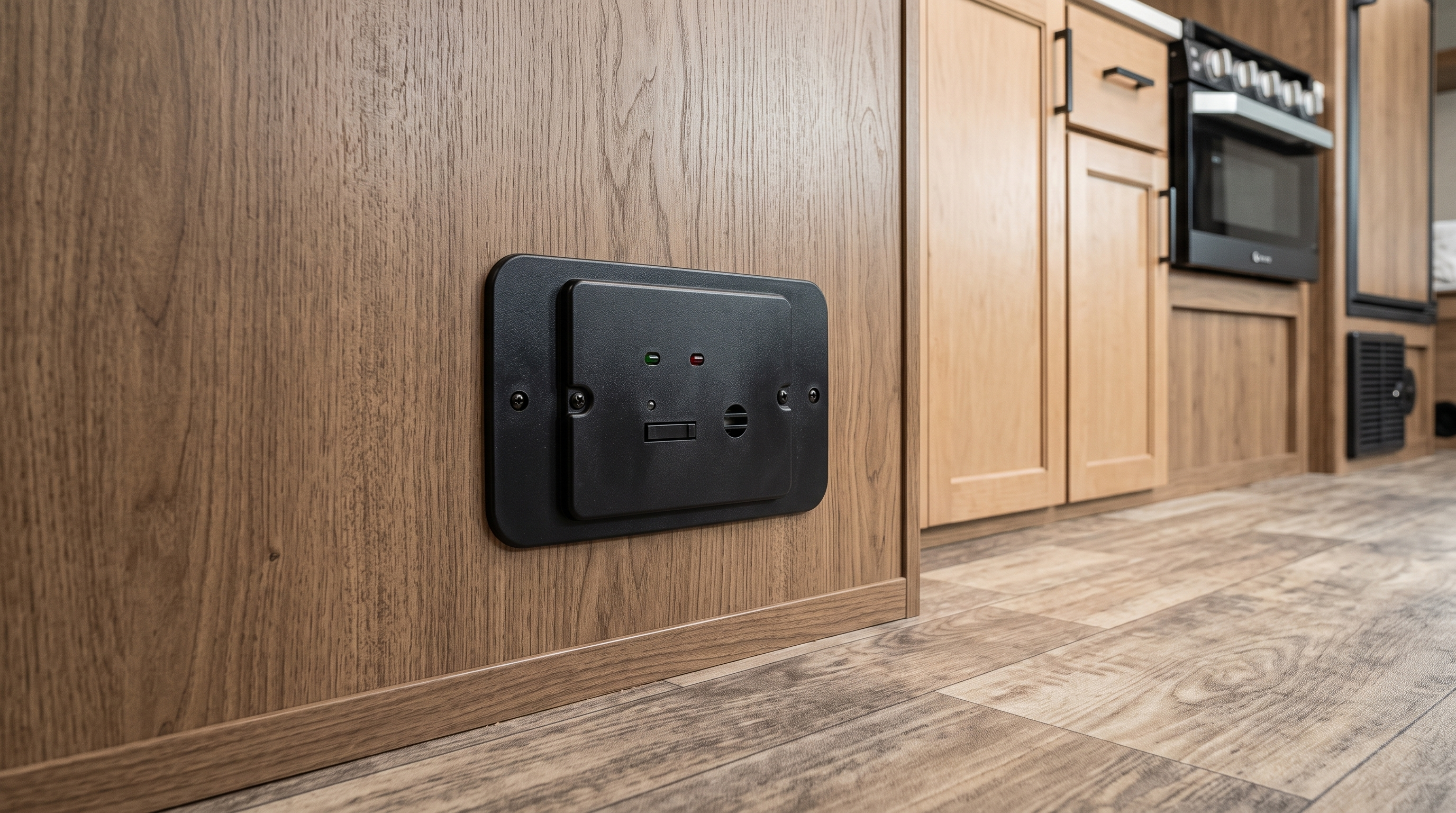
The 25 Series manual specifies installation in the kitchen area near potential gas-leak sources and between four and twenty inches above the floor. It should not be installed behind furniture or drapes, in a closet, on an outside wall, or within twelve inches of an opening window, exterior door, heating vent or return vent.
That low position is largely about propane, which is heavier than air. Carbon monoxide mixes with surrounding air. The old article’s statement that both gases simply hover low was inaccurate.
Wiring and replacement considerations
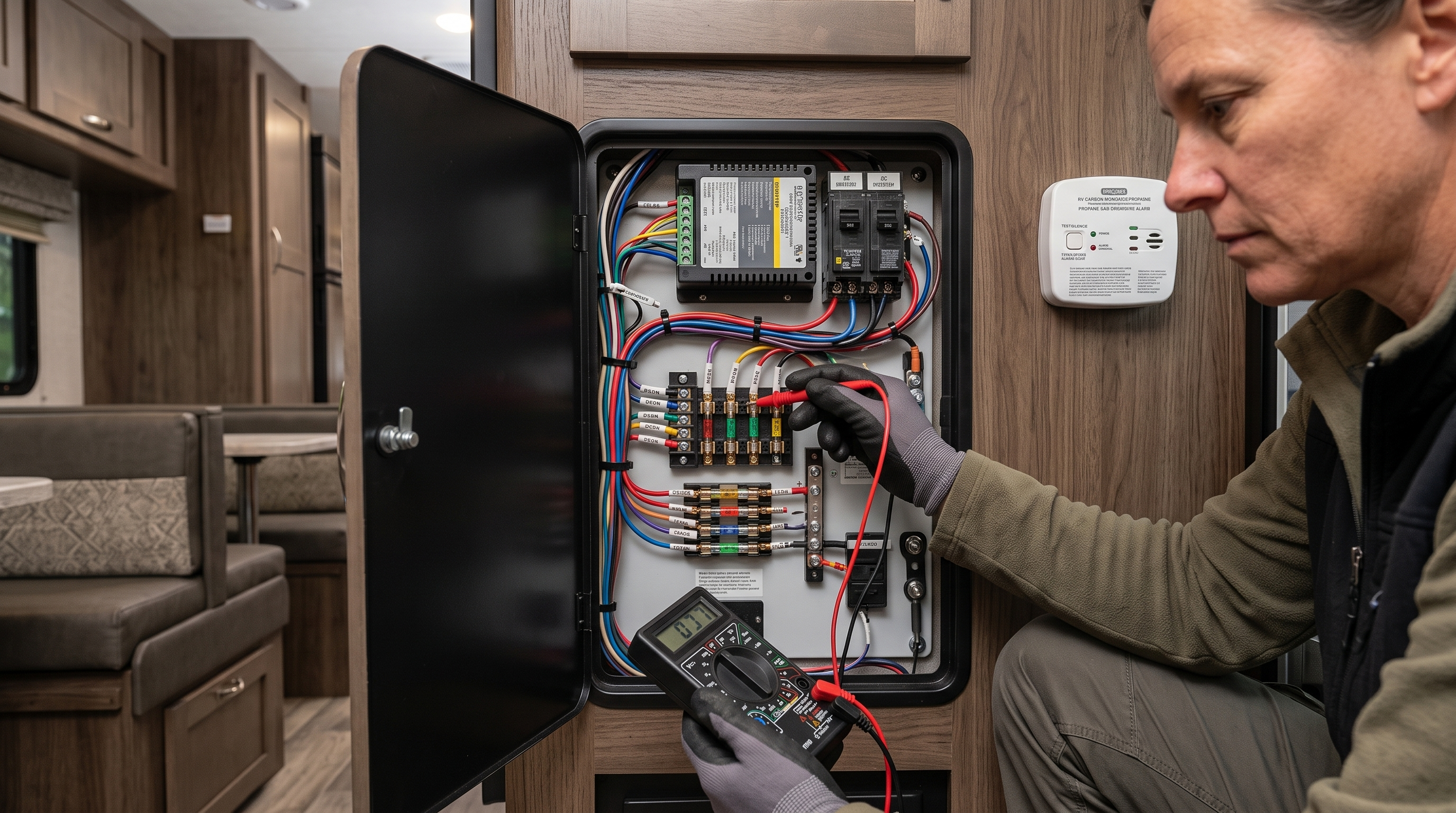
The 25‑742 is not a battery-powered household detector. It uses two hardwired leads: red to the properly fused 12-volt positive circuit and black to ground. Safe‑T‑Alert calls for permanent recognized wire connectors, 14- to 18-gauge wire and a circuit that occupants cannot casually switch off. Power must be disconnected before installation.
If you are not comfortable identifying polarity, verifying the fuse, checking the cavity and making code-compliant connections, this is an appropriate job for an RV technician. The manufacturer also notes that the RV must not be occupied when the main 12-volt disconnect—and therefore the alarm—is off.
What the beep patterns mean
| 25 Series pattern | Meaning | Response |
|---|---|---|
| Four beeps, then five seconds off; red CO indicator | Carbon monoxide detected | Evacuate immediately and follow the CO emergency procedure. |
| Continuous beeping; flashing red gas indicator | Dangerous propane level | Avoid ignition sources, evacuate and follow the gas-emergency procedure. |
| One beep approximately every 30 seconds; alternating red/green | Malfunction or service warning | Check voltage after safety is established; replace or service if it will not clear. |
| Beep every 25–30 seconds; red-red-green-green | End of five-year sensor life | Replace the alarm. Resetting only provides a temporary window. |
| Flashing green after initial power-up | Warm-up period | Wait for the specified cycle and confirm steady green operation. |
Never assume a loud alarm is a “false alarm.” Move everyone into fresh air, identify the signal and rule out CO or propane first. Our separate guide explains why an RV carbon monoxide alarm keeps going off and the safe troubleshooting order for alarms, chirps and low-voltage warnings.
Our experience with unexpected alarms
Our original review came from genuine experience: we had the alarm wake us at night more than once, and certain cleaners or airborne products seemed connected to some of those events. The updated manual supports part of that observation. Safe‑T‑Alert says acetone, alcohol, butane and gasoline may trigger the explosive-gas sensor, and it warns that cleaning agents, waxes and silicone-based products can cause an alarm, malfunction or sensor damage.
What we cannot safely do is work backward from a possible contaminant and declare the event harmless. A furnace, generator, water heater, stove, oven, engine, portable heater, damaged exhaust system or neighbouring campsite can create real CO. A propane-system leak can also produce a real gas alarm. The correct order is evacuation, signal identification, source investigation and only then a conclusion.
Testing and maintenance
The test button checks the alarm’s electrical functions, indicator lights and horn. It does not confirm the sensors’ response to gas. Safe‑T‑Alert explicitly says not to generate carbon monoxide for testing. For the 25 Series, the company recommends an operational test after storage, before each trip and at least once per week during use.
Maintenance is simple but specific:
- Vacuum dust from the alarm cover with a soft brush attachment at least monthly.
- Clean the cover only with a cloth dampened in clean water, then dry it.
- Do not spray cleaners, waxes or silicone products on or near the alarm.
- Check for a steady green operational indicator during regular inspections.
- Record the installation date and replacement date where they will not be forgotten.
- Replace the complete unit after five years or sooner if it fails testing or indicates a persistent malfunction.
Safe‑T‑Alert 25‑742 pros and cons
What we like
- Combines CO and propane detection in one compact RV-listed unit.
- Hardwired 12-volt power eliminates forgotten disposable batteries.
- Different alarm patterns help separate CO, propane, malfunction and end-of-life conditions.
- Available in black or white and compatible with an optional trim-ring version.
- Test/mute control and automatic reactivation if danger remains.
- Direct replacement suitability for specified older Atwood models, according to Safe‑T‑Alert.
What gives us pause
- Five-year life means replacement is a scheduled ownership cost.
- No numeric CO display, event memory or phone notification.
- No backup power if the RV’s 12-volt circuit is disconnected or fails.
- One-year warranty is much shorter than the five-year service life.
- Official product-page and manual cutout measurements do not match.
- Airborne solvents and certain gases can affect the propane sensor.
Who should buy the 25‑742?
The 25‑742 makes the most sense for an RV owner replacing a flush-mounted 12-volt dual alarm where:
- the existing location complies with the current installation instructions;
- the opening and one-inch wall clearance fit the actual purchased unit;
- the wiring provides correct, reliable and properly fused 12-volt power; and
- a standard audible and visual alarm is sufficient without a display or connected alerts.
Who should consider another model?
Consider another RV-listed option when the existing opening is much larger, the alarm location is unsuitable, you need accessibility features, or you specifically want a digital concentration display, event history or remote alerts. The Safe‑T‑Alert 85‑741‑TR may simplify some larger-opening replacements because its trim ring is designed for universal coverage, but measurements and placement still need verification.
A portable household CO alarm can provide an additional layer in some situations, but it does not automatically replace the RV’s permanently installed propane alarm or satisfy the requirements for the original RV installation. Follow the RV manufacturer, alarm manufacturer and applicable code requirements.
Final verdict: still worth buying?
Yes—when it matches the opening, wiring and mounting location. The Safe‑T‑Alert 25‑742 is a straightforward, purpose-built RV safety device. It does not offer smart-home extras, but it does the important work of monitoring for two different hazards and clearly distinguishes its major warning states.
Its biggest limitation is not performance marketing; it is fit. Confirm the date, wall opening, cavity depth and installation location before ordering. Once installed, test it on schedule, keep the sensor openings clean and replace it at five years rather than trying to stretch a safety device beyond its stated life.
Check the current model before ordering
Safe‑T‑Alert listed the 25‑742 at US$123.20 when this review was updated on September 19, 2026. Prices and availability can change, so verify the current specifications and included trim pieces directly with the manufacturer.
Frequently asked questions
Is the Safe‑T‑Alert 25‑742 discontinued?
No. Safe‑T‑Alert currently lists model 25‑742 for sale on its official website. Availability through individual RV dealers and retailers can vary.
How long does a Safe‑T‑Alert 25‑742 last?
The manufacturer specifies a five-year service life. The alarm has an end-of-life signal and should be replaced five years after installation or by the date determined from the production label when the installation date is unknown.
Does the Safe‑T‑Alert 25‑742 have a battery?
It is powered by the RV’s 12-volt DC system and does not use a user-replaceable backup battery. It will not protect occupants when its 12-volt circuit has no power.
What size is the Safe‑T‑Alert 25‑742?
The case is listed as 4.5 inches wide, 3.25 inches high and 1.25 inches deep. Verify the cutout using the template or instructions supplied with the purchased unit because the current product page and linked manual list different opening measurements.
Can I replace my old propane detector with a 25‑742?
Potentially. The 25‑742 upgrades a compatible 12-volt propane-alarm installation to dual CO/LP protection, but the opening, cavity, wiring and placement must meet the current instructions. Safe‑T‑Alert specifically lists it as suitable for replacing Atwood models 31013 and 31014.
Can I silence the alarm with the mute button?
The mute function temporarily silences the horn while the RV is ventilated, but the alarm can reactivate if dangerous CO or propane remains. Muting is not a substitute for evacuation, source repair or replacement of an expired unit.
Does the test button prove both sensors work?
No. The manufacturer says the button tests the electrical functions, lights and horn but does not test the sensors’ response to gas. Never generate carbon monoxide to test it.
What is the warranty on the 25‑742?
Safe‑T‑Alert lists a one-year limited warranty against defects in materials or workmanship for the original retail purchaser, subject to its warranty terms.
Sources and specifications


Leave a Reply