

Last Updated on September 14, 2026 by Jeremy
Canada has a way of getting under your skin.
Maybe it’s watching the morning mist roll across a mountain lake before anyone else is awake. Maybe it’s spotting a black bear from a safe distance, hiking through forests that seem endless, or pulling into a campground where your neighbours become friends before supper is even cooked.
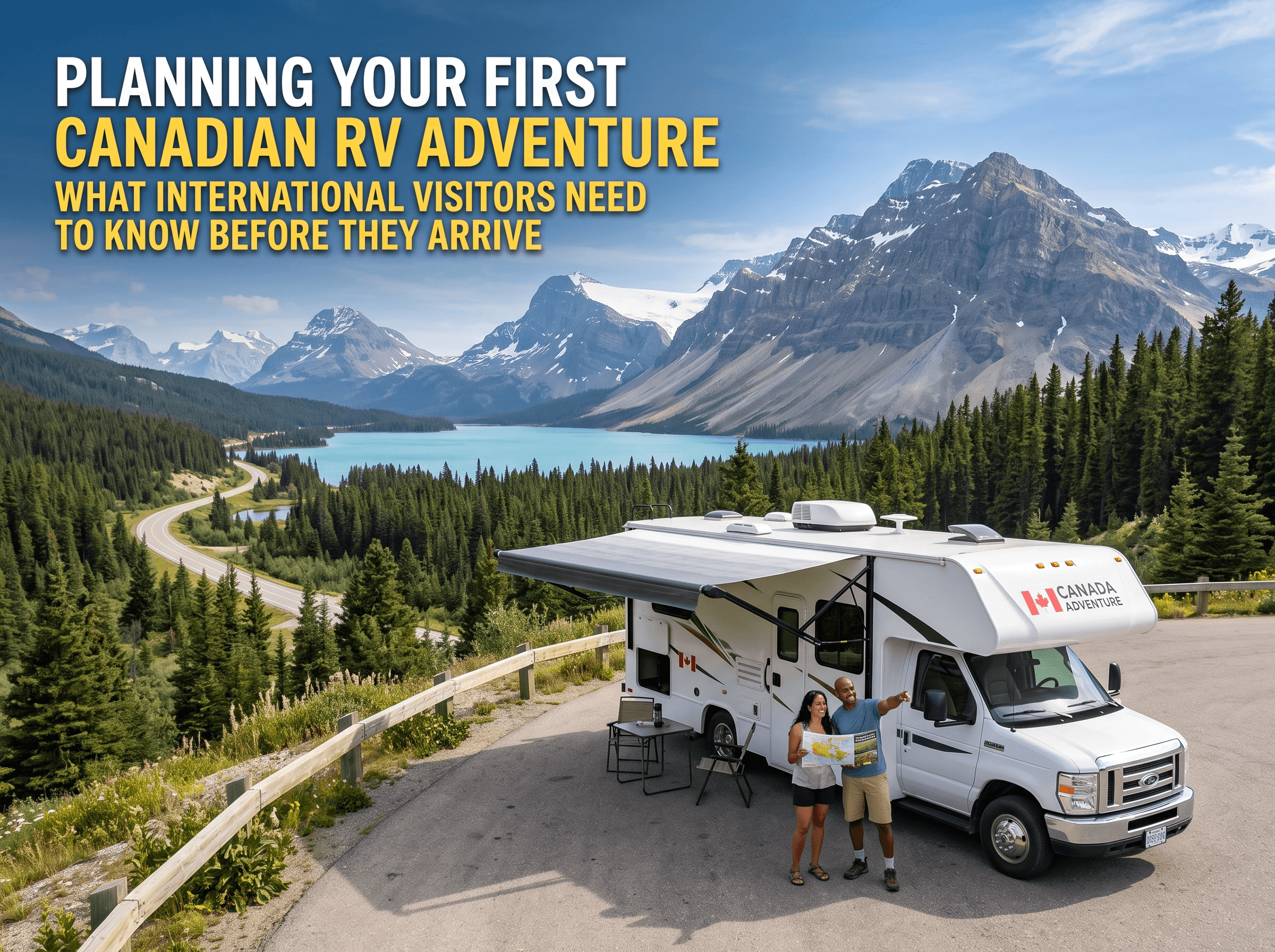
Every year, thousands of international visitors choose to experience Canada exactly this way—behind the wheel of a rental RV.

During four seasons working inside British Columbia provincial parks, I had the opportunity to meet hundreds of these travellers. One group stood out more than any other: visitors from Germany. Many travelled in small groups, rented motorhomes from companies like CanaDream, Cruise Canada, Fraserway, or Cruise America, and spent three to four weeks exploring Western Canada before flying home.
Over time I noticed something interesting.
It wasn’t the driving that challenged them.
It wasn’t even learning how to use the RV.
It was planning.
Questions about campgrounds. Reservations. Wildlife. Fire bans. Distances between towns. Cell service. Overnight parking. Which apps to download. Which memberships were actually worth buying.
Many of those same questions came across our campground counter almost every day.
Sometimes I’d recommend an app like AllStays, and within minutes they’d have it downloaded because the itinerary they’d been given simply wasn’t flexible enough for the adventure they wanted.
That experience inspired this guide.
This isn’t another article explaining how to rent an RV—that’s already covered in my Beginner’s Guide to Renting a Motorhome.
Instead, this guide picks up where that one ends.
If you’re visiting Canada and want to experience the country by RV, here’s everything I wish every international visitor knew before arriving.
Before We Begin: Your Canadian RV Planning Roadmap
Rather than jumping between dozens of websites while trying to organize your holiday, think of this guide as your central planning hub.
Throughout this article I’ll point you toward the resources on Everything RVs and More that can make planning much easier.
⭐ Memberships
Discover campground discounts, planning tools and overnight stays.
What Four Seasons Working In Canadian Campgrounds Taught Me About International RV Travellers

When most people imagine campground staff, they picture someone checking reservations or selling bundles of firewood.
Sure, that’s part of the job.
But park operators also become unofficial travel advisors.
Every summer we’d answer hundreds of questions.
- Where should we stop tomorrow?
- Is Jasper worth the drive?
- Can we sleep in a Walmart parking lot?
- How far is Banff?
- Will we see bears?
- Do we need reservations?
- Is there another campground nearby?
- Where can we dump our tanks?
The questions rarely changed.
The countries did.
Visitors came from Germany, Switzerland, the Netherlands, France, Australia, the United Kingdom, and many other parts of the world.
But German visitors were consistently among the largest groups travelling through our parks.
Many arrived with carefully planned itineraries that had been organized months before.
Others quickly discovered that travel rarely goes exactly according to plan.
Maybe they wanted to stay longer beside a beautiful lake.
Maybe the weather changed.
Maybe another camper recommended somewhere even better.
That’s when flexibility became important.
The happiest travellers weren’t necessarily the ones with the most detailed itinerary.
They were the ones who had the right planning tools available when plans inevitably changed.
Step 1: Choose The Right RV Before You Book Anything Else
One of the biggest mistakes first-time visitors make isn’t choosing the wrong campground.
It’s choosing the wrong RV.
A family of five travelling through the Canadian Rockies has completely different needs than a retired couple exploring Vancouver Island.
Likewise, someone planning to move every day may appreciate a smaller Class C motorhome, while travellers spending a week at each campground may enjoy the extra living space of a larger coach.
Before booking campsites, memberships, or attractions, make sure you’ve selected the right style of RV for your adventure.
That’s exactly why I created this guide:
Beginner’s Guide to Renting a Motorhome
Inside you’ll find:
- Choosing between Class A, B and C motorhomes
- Comparing Cruise America, Outdoorsy and RVezy
- Insurance considerations
- Rental walkthrough tips
- Packing advice
- Beginner mistakes to avoid
Once you’ve chosen your RV, it’s time to start planning the adventure itself.
Step 2: Canada Is Bigger Than You Think

If there’s one thing nearly every international visitor underestimates, it’s distance.
On a map, Banff, Jasper, Vancouver, Calgary, and Whistler can appear surprisingly close together.
In reality, Canada rewards travellers who slow down.
Driving six or seven hours every day quickly turns an unforgettable vacation into little more than a windshield tour.
Instead of asking, “How much can we see?” ask yourself:
- How much do we actually want to experience?
- Where do we want to hike?
- Where do we want to spend an extra day?
- Which places deserve more than a quick photograph?
This is also where budgeting becomes important.
Fuel, campground fees, groceries, attractions, and unexpected detours all add up over a three or four week journey.
Before finalizing your itinerary, I recommend using the RV Trip Cost Estimator. It gives you a realistic picture of what your road trip may cost before you even leave home.
Step 3: Finding Campgrounds Without Turning Your Vacation Into A Reservation Marathon

Once you’ve chosen your RV and mapped out a general route, the next question becomes:
“Where are we actually going to stay?”
This is where many first-time visitors begin to feel overwhelmed.
Canada has thousands of places to camp.
Provincial parks.
National parks.
Private RV resorts.
Municipal campgrounds.
Forest recreation sites.
Harvest Hosts locations.
Free camping opportunities.
The choices are almost endless.
Ironically, that’s exactly what makes planning difficult.
Over the years I met plenty of travellers who had every campground booked months in advance.
I also met travellers who arrived hoping something would simply be available.
Both approaches have drawbacks.
Reserve absolutely everything, and you lose flexibility.
Reserve nothing, and you may spend your afternoon driving from campground to campground hoping someone cancelled.
The sweet spot is somewhere in between.
Book the destinations you absolutely don’t want to miss—places like Banff, Jasper, Lake Louise, or popular summer destinations—then leave yourself enough flexibility to adjust the rest of the trip as you discover new places along the way.
Canadian Campgrounds Are Very Different From European Campgrounds
This surprised quite a few visitors.
European campgrounds often feel more centralized, with towns, grocery stores, fuel stations, and services located fairly close together.
Canada is different.
You might drive for hours between communities.
Your campground could be tucked beside an incredible mountain lake with absolutely no grocery store nearby.
Cell service may disappear.
Fuel stations become less frequent.
Wildlife becomes more common than traffic.
That isn’t a downside.
It’s one of the reasons people travel here.
But it does require a little more planning.
| European Camping | Canadian Camping |
|---|---|
| Towns usually nearby | Longer distances between services |
| More developed campgrounds | Mix of full-service and rustic parks |
| Shorter driving days | Long scenic highway drives |
| Less wildlife interaction | Bears, elk, deer and other wildlife are common |
| Urban conveniences nearby | Nature often comes first |
Finding The Right Campground Is Easier Than You Think
One thing I noticed over four seasons was that many visitors simply accepted whichever campground appeared on their original itinerary.
Sometimes that worked perfectly.
Sometimes it didn’t.
Maybe they wanted more privacy.
Maybe they preferred lakes instead of forests.
Maybe they wanted hookups.
Maybe they wanted hiking trails instead of playgrounds.
Everyone camps differently.
That’s exactly why I built the Campground Picker Tool.
Instead of randomly searching Google or opening twenty browser tabs, it helps narrow your choices based on the kind of camping experience you’re actually looking for.
Find the Perfect Campground for Your Next Adventure →
The best campground isn’t always the closest one.
Sometimes driving another thirty minutes gives you quieter surroundings, better scenery, easier reservations, larger campsites, or a much better overall experience.
Jeremy’s Hidden Campground Suggestions
Most rental itineraries point international visitors toward the same famous places: Banff, Jasper, Whistler, Vancouver Island, and the big-name national parks.
Those places are popular for a reason, but some of my favourite Canadian RV stops are the quieter places travellers often miss.
One campground I will always recommend is Silver Beach Provincial Park near Seymour Arm on the northern Shuswap. The sand there is the reason it stands out. It feels different from many rocky lakefront campgrounds in British Columbia, and if you want a peaceful lake-focused stop that feels more local than touristy, it belongs on your radar.
You can learn more about the area here: Seymour Arm BC.
If you’re building a Western Canada RV route and want campground ideas beyond the obvious tourist trail, these guides are also worth reading:
My advice: leave room in your itinerary for at least one place that wasn’t handed to you by a rental company. Sometimes those are the stops you remember most.
Step 4: Build Your Canadian RV Travel Toolkit

This is probably the advice I gave more often than almost anything else.
Not because people were doing something wrong.
Because they simply didn’t know these tools existed.
I remember talking with one German couple who weren’t thrilled with the route they’d been given.
They felt locked into their itinerary and wanted to explore more spontaneous overnight stops.
I suggested downloading AllStays.
Within minutes they were scrolling through nearby campgrounds, dump stations, fuel stops, overnight parking options, and alternate routes they hadn’t even considered.
The look on their faces said everything.
Suddenly, they weren’t following someone else’s vacation.
They were creating their own.
Start With Camping Apps
Before arriving in Canada, I recommend downloading the camping and navigation apps you’ll actually use.
Rather than filling your phone with dozens of apps, start with a carefully selected group that covers campground research, navigation, weather, hiking, emergency information, and route planning.
I cover those in detail here:
The Best Camping Apps to Elevate Your Outdoor Adventures →
That guide includes recommendations like:
- AllStays
- Roadtrippers
- The Dyrt
- iOverlander
- Gaia GPS
- AllTrails
- Windy
- Recreation.gov
- First Aid by Red Cross
Most importantly, it also points you toward our Affiliate Brand Directory whenever a deeper review or setup guide is available.
Several Canadian mountain regions have limited cell coverage. Download offline maps while you still have reliable Wi-Fi or mobile service.
Step 5: Don’t Buy Every Membership… Buy The Right Ones

One mistake I see online all the time is people recommending every RV membership available.
Honestly?
You probably don’t need most of them.
The right membership depends entirely on how you travel.
If your goal is unique overnight experiences, one membership makes sense.
If you’re trying to save money on campgrounds, another may be a better fit.
If route planning is your biggest concern, you’ll likely benefit from something completely different.
That’s why I built an entire comparison hub instead of recommending everything equally.
Best RV Memberships, Campground Apps & Travel Clubs →
Inside you’ll find straightforward comparisons between:
- Harvest Hosts
- AllStays
- RV LIFE Trip Wizard
- Roadtrippers Plus
- Good Sam Club
- KOA Rewards
- Campspot
- Passport America
- Escapees RV Club
Rather than trying to sell you on every membership, the guide helps match each one to the type of traveller you are.
That’s a much better way to spend your travel budget.
Step 6: The Biggest Mistakes I Watched International Visitors Make (So You Don’t Have To)

One of the unexpected benefits of working inside Canadian campgrounds for four seasons was seeing hundreds of vacations unfold in real time.
Some families looked completely relaxed from the moment they arrived.
Others… well… you could almost see the stress climbing out of the driver’s seat before the RV door even opened.
The interesting part?
It usually wasn’t because they were inexperienced.
It was because nobody had prepared them for what travelling through Canada is actually like.
If I could go back and hand every international visitor one page of advice before they landed, it would probably include these lessons.
1. Canada Is Huge… Don’t Try To See All Of It
This was probably the biggest surprise.
Visitors would arrive with a map that looked fantastic on paper.
Vancouver.
Whistler.
Banff.
Jasper.
Calgary.
Drumheller.
Back to Vancouver.
All in twelve days.
Technically possible?
Sure.
Enjoyable?
Probably not.
One thing Canada rewards is slowing down.
Spend an extra day beside that lake.
Take the hike.
Watch the sunrise.
Sit around the campfire.
Those are the memories you’ll still be talking about years later—not the extra 600 kilometres you squeezed into your itinerary.
I generally tell people to plan fewer destinations and spend more time enjoying each one. Canada isn’t a country you “finish.”
2. Campgrounds Fill Faster Than Many Visitors Expect
Especially during July and August.
Banff.
Jasper.
Yoho.
Glacier National Park.
Many provincial parks.
Popular private campgrounds.
They can all book months in advance.
That doesn’t mean your trip is ruined if you don’t have every night reserved.
It simply means your must-see destinations should be booked early.
The rest can often remain flexible.
3. Fuel Stops Matter More Than You Think
Back home, you may never think twice about driving another twenty minutes before filling up.
In parts of Canada?
That extra twenty minutes could become another two hours.
Fuel stations become much less frequent once you leave larger communities.
Whenever your tank starts getting low, don’t assume another station is just around the corner.
Especially in northern British Columbia, Alberta mountain routes, or more remote highways.
4. Wildlife Is Amazing… Until You Forget It’s Wildlife
Seeing elk walking through a campground.
Watching a black bear feeding across a valley.
Mountain goats standing beside the highway.
These are incredible experiences.
They’re also wild animals.
One thing I appreciated about most international visitors was how respectful they generally were around wildlife.
Keep your distance.
Store food properly.
Never feed animals.
Take photographs with your zoom lens—not your feet.
If an animal changes its behaviour because of your presence, you’re already too close.
5. Cell Service Isn’t Guaranteed
This catches people off guard every year.
You’ll have excellent reception in one town…
…then nothing for the next hour.
Download offline maps.
Save campground confirmations.
Keep emergency numbers accessible.
And don’t rely entirely on streaming navigation.
6. Flexibility Usually Creates The Best Memories
Some of my favourite conversations happened with travellers who changed their plans.
Someone recommended a hidden lake.
A campground host mentioned a local festival.
Another camper suggested taking a scenic highway instead.
Those spontaneous decisions often became the highlight of the trip.
Leave yourself room for those moments.
Canadian Camping Etiquette Every Visitor Should Know
One thing I genuinely appreciated about most international visitors was how respectful they were.
They wanted to do things properly.
They simply didn’t always know what “properly” looked like in Canadian campgrounds.
Fortunately, campground etiquette isn’t complicated.
| Good Camping Etiquette | Why It Matters |
|---|---|
| Observe quiet hours. | Your neighbours probably woke up early to enjoy the outdoors. |
| Store food securely. | Protects both people and wildlife. |
| Leave your campsite clean. | The next camper should arrive to a clean site. |
| Keep pets under control. | Not everyone is comfortable around unfamiliar animals. |
| Respect fire bans. | Wildfire risk is taken extremely seriously in Canada. |
| Drive slowly. | Children, cyclists, and wildlife share campground roads. |
Honestly, campground etiquette comes down to one simple principle.
Leave the campsite, the campground, and the people around you with a positive impression.
It’s amazing how far that attitude goes.
What I Recommended Most Often At The Campground Office

If someone asked me, “Jeremy, if you were planning this trip yourself, where would you start?” my answer usually looked something like this.
- Choose the right rental RV.
- Estimate the total trip budget.
- Book your must-see campgrounds early.
- Use the Campground Picker Tool to find alternatives.
- Download your camping apps before leaving the city.
- Choose only the memberships that match your travel style.
- Leave enough flexibility for unexpected discoveries.
Notice what’s missing?
Trying to schedule every minute.
The best Canadian RV adventures almost always include moments you never planned for.
Years from now, you probably won’t remember Campsite #42.
You’ll remember the moose standing beside the highway.
The strangers who became friends around the campfire.
The glacier you weren’t expecting.
The mountain lake you almost drove past.
That’s why flexibility is one of the best things you can pack.
Your Canadian RV Adventure Checklist
Before boarding your flight to Canada, here’s the checklist I’d personally work through.
- ✓ Rental RV booked
- ✓ Passport and travel documents confirmed
- ✓ Campgrounds reserved for key destinations
- ✓ Flexible days built into your itinerary
- ✓ Budget estimated using the RV Trip Cost Estimator
- ✓ Campground Picker Tool bookmarked
- ✓ Camping apps downloaded for offline use
- ✓ RV memberships researched
- ✓ Emergency contacts saved
- ✓ Offline maps downloaded
- ✓ Camera charged
- ✓ Sense of adventure packed
Final Thoughts: Canada Isn’t A Race… It’s An Experience
Over the years, I watched hundreds of RVs roll through campground gates.
Some travellers stayed one night.
Others spent weeks exploring the country.
Many eventually returned a second time because one trip simply wasn’t enough.
If there’s one thing I hope you take away from this guide, it’s this:
Don’t try to see all of Canada.
Experience the part you’re in.
Talk to fellow campers.
Listen to local recommendations.
Take the scenic route when time allows.
Stop at the roadside viewpoint.
Spend one more evening around the campfire.
Those are the moments that transform an RV vacation into the adventure people dream about long after they’ve flown home.


Leave a Reply