

Last Updated on October 1, 2026 by Jeremy
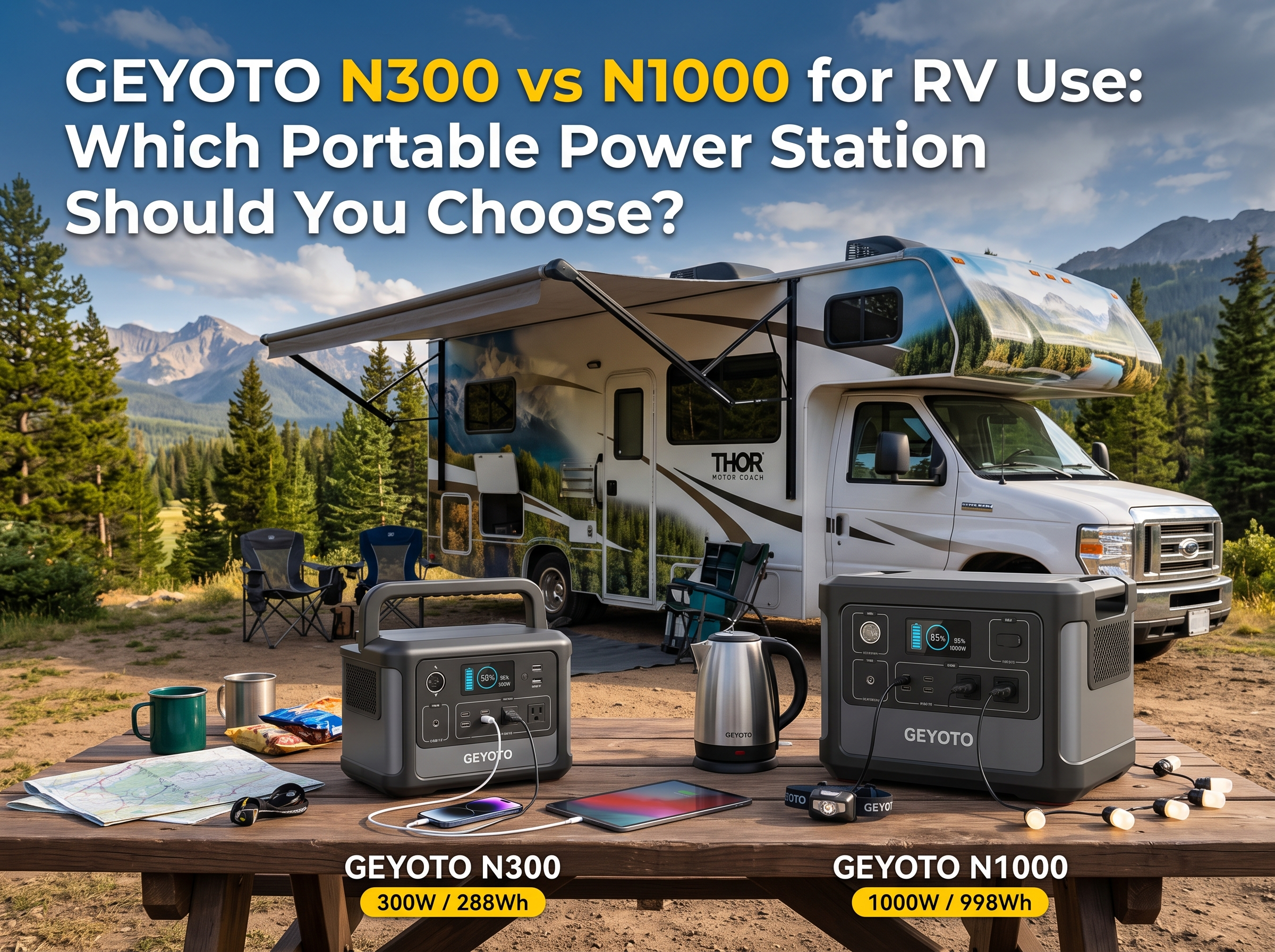
Choosing between the GEYOTO N300 and N1000 is not really a question of which portable power station is “better.” It is a question of what you expect it to do once campground power disappears.
The N300 is a compact 256Wh unit built around lighter electrical loads. The N1000 increases capacity to 1,024Wh and raises continuous AC output from 300W to 1,800W. That is a major jump, but it also means more weight, more storage space and a higher purchase cost.
I have not personally tested either GEYOTO model, so this is not being presented as a hands-on product review. It is a specification-based comparison shaped by four seasons of managing RV power, several disappointing attempts at small solar, multiple generator upgrades and real experience using a roughly 1,000Wh-class EcoFlow to keep our mobile office operating.
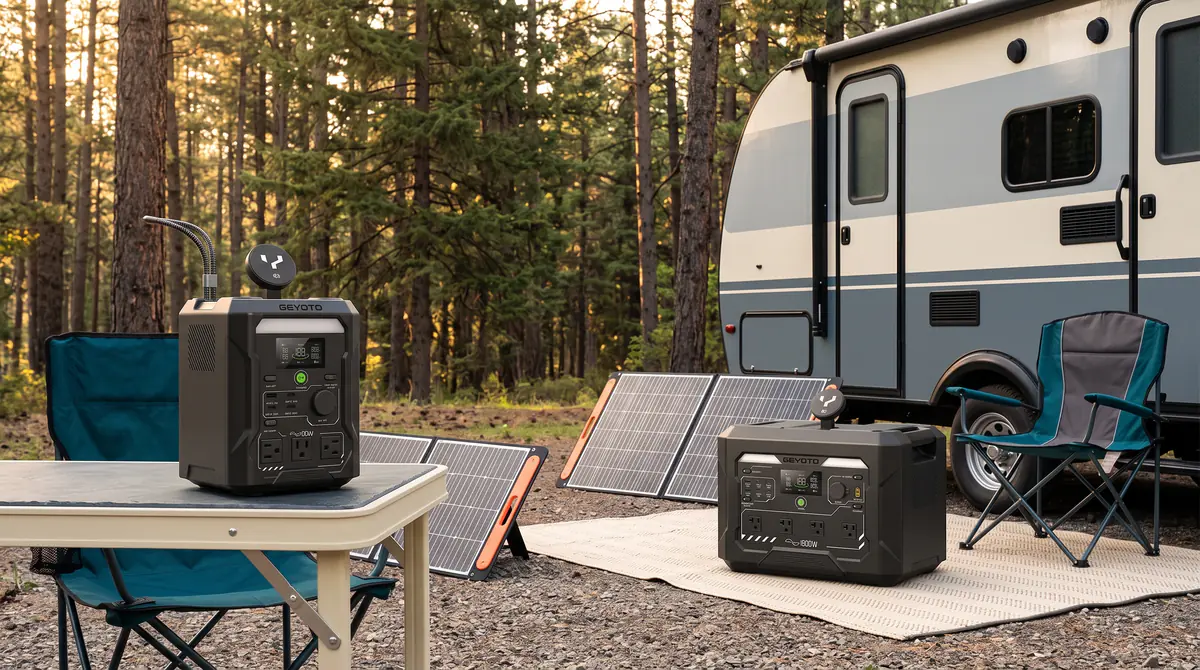
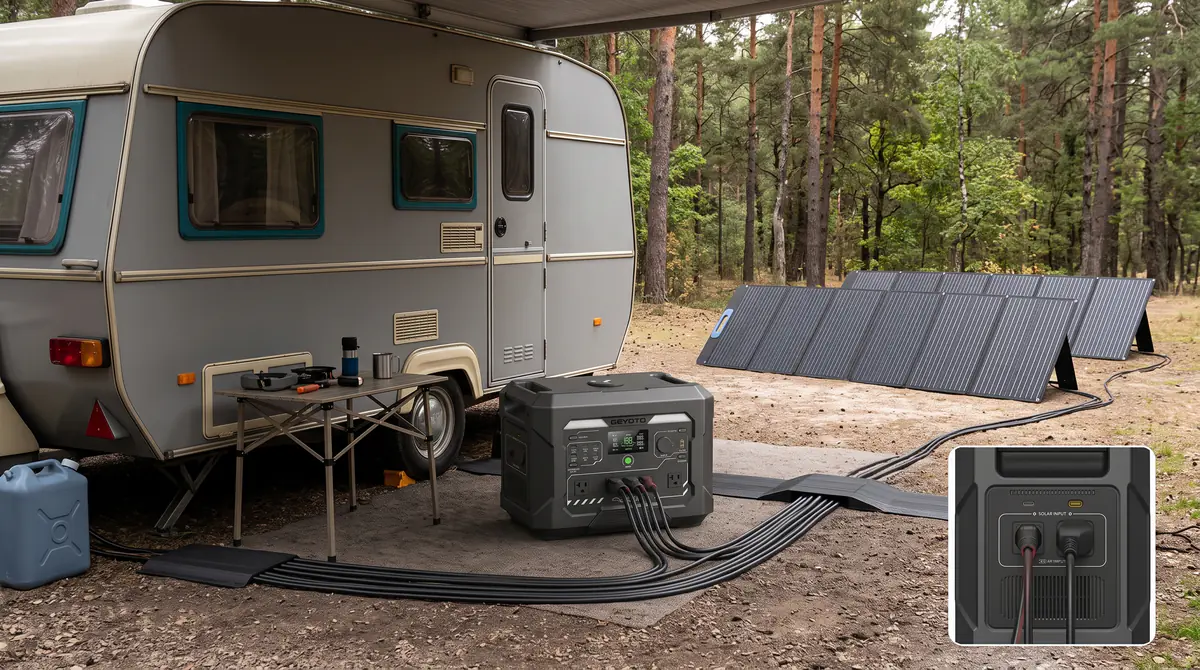
Image disclosure: Supporting images in this article were created with AI for illustrative purposes. Product specifications and practical recommendations were verified separately.
Quick Answer
- Choose the GEYOTO N300 for phones, laptops, cameras, lighting, routers and shorter-duration light loads where portability matters most.
- Choose the GEYOTO N1000 for a mobile office, longer runtimes, portable refrigeration, CPAP use or appliances that exceed the N300’s 300W continuous limit.
- Choose neither yet if you have not calculated your daily watt-hours and maximum simultaneous load. Start with the RV Solar Power Hub and calculator.
- Neither model should automatically be treated as a complete replacement for a properly sized RV electrical system or generator.
Affiliate disclosure: This article contains links to our GEYOTO brand page, which may include affiliate links. If you make a purchase through one of those links, we may earn a commission at no additional cost to you.
GEYOTO N300 vs N1000 Specifications
| Specification | GEYOTO N300 | GEYOTO N1000 | What It Means in an RV |
|---|---|---|---|
| Battery capacity | 256Wh | 1,024Wh | The N1000 stores four times as much rated energy. |
| Continuous AC output | 300W | 1,800W pure sine wave | The N1000 supports a much wider range of appliances, provided their running and startup demands remain within its limits. |
| Peak output | 500W | 3,000W | Peak ratings help with brief startup demand. They are not continuous operating limits. |
| Battery chemistry | LiFePO4 | LiFePO4 | Both use a chemistry associated with good cycle life and thermal stability. |
| Claimed battery cycles | 4,000 | 4,000 | Useful for repeated camping and backup use, although capacity gradually declines with age and use. |
| Output connections | 9 | 13 | More ports are useful, but total output limits still apply across all connected devices. |
| Maximum solar input | 140W | 800W | The N1000 can accept substantially more solar with compatible panels and suitable conditions. |
| Weight without silicone armour | 7.72 lb / 3.5 kg | 25.57 lb / 11.6 kg | The N300 is grab-and-go. The N1000 is transportable, but substantially heavier. |
| App control | Wi-Fi and Bluetooth | Wi-Fi and Bluetooth | Both can be monitored without constantly bending down to check the display. |
| Advertised member warranty | 5 years | 5 years | Confirm registration, regional availability and current warranty terms before ordering. |
Specifications were verified using GEYOTO’s official N300 product page and N1000 product page. Product bundles, prices, shipping regions and warranty conditions can change.
The Difference Between Watts and Watt-Hours
This is where portable-power shopping frequently goes sideways.
Watts tell you how much power a station can deliver at one moment. Watt-hours tell you how much energy its battery stores. You need both numbers.
A 1,200W coffee maker might only run for several minutes, but the N300 cannot operate it because the appliance exceeds the station’s 300W continuous AC limit.
A 60W laptop fits comfortably within that limit, but runtime still depends on how many watt-hours remain in the battery.
Simple Planning Formula
Estimated runtime = battery capacity in Wh × 0.80 ÷ average load in watts
The 0.80 factor provides a conservative allowance for inverter loss, conversion loss and reserve capacity. Actual results vary with temperature, appliance cycling, battery condition and usage.
Using that formula, the N300 provides roughly 205Wh of planning energy and the N1000 about 819Wh.
A steady 60W load works out to approximately 3.4 hours on the N300 or 13.7 hours on the N1000. Compressors cycle, printers create short demand spikes, laptop charging tapers and cold weather can affect battery performance.
What Four Camping Seasons Taught Me About Power
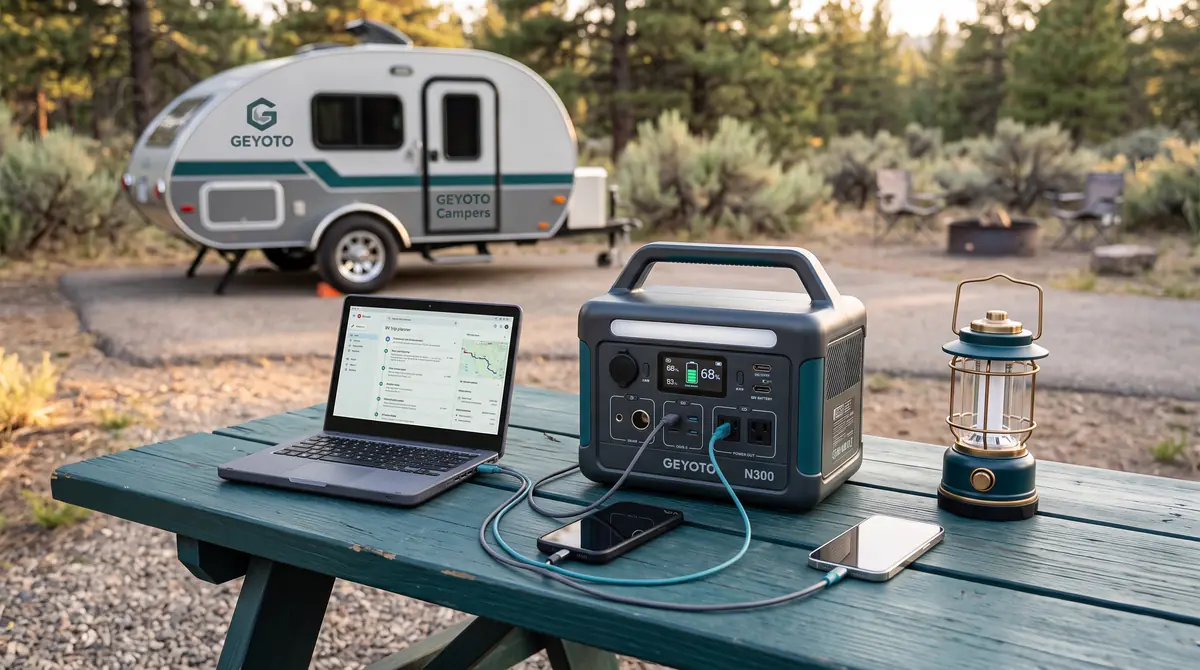
During our first season operating a campground, I tried using one of the smaller solar kits sold through Canadian Tire.
The current kits have improved, but our setup at the time failed miserably at what we expected it to accomplish. We did not run the generator less. We ran it more.
For our second season, we increased the setup to two panels. Once again, the energy coming back into the system did not consistently match what we were consuming.
By season three, we upgraded the generator. During season four, we upgraded again to our Benchmark inverter generator. The company-provided trailer also had solar installed, but that system never seemed to produce what we expected from it.
That experience changed how I evaluate portable power.
I no longer look at a battery station and ask only, “How big is it?” I want to know what it can operate, how long it can do it and how realistically I can recharge it before the battery is empty.
- What will I actually run?
- How many watts will those devices draw at the same time?
- How many hours per day will I use them?
- How much energy can I realistically put back before the battery empties?
- What is my backup when weather, shade or travel interrupts solar charging?
We later used an EcoFlow in approximately the same capacity class as the N1000. Under our usage pattern, it supported our mobile-office equipment, primarily a laptop and printer, through roughly a full 12-hour workday.
That is not a laboratory comparison with the GEYOTO N1000. A printer’s intermittent demand is also different from a constant load. It does demonstrate why the 1,000Wh class can be useful when portable power supports your work instead of only charging a phone.
If you want the generator side of that experience, read our Benchmark 4500W inverter generator review. It includes the benefits, the breakdowns and the ownership details product listings tend to skip.
Who Should Choose the GEYOTO N300?
The N300 makes the most sense when portability matters more than endurance. At 7.72 pounds without its silicone armour, it can be moved easily between an RV, tow vehicle, picnic table and home.
Good Uses for the N300
- Phones, tablets, cameras and drone batteries
- A laptop or other light office electronics for shorter sessions
- LED lighting, small fans and an internet router
- Day trips, tent camping and emergency communication
- Keeping small electronics away from the RV’s main battery bank
Where the N300 Becomes the Wrong Tool
A 300W continuous output limit rules out many heat-producing appliances and larger kitchen devices. Its 256Wh battery also drains quickly when asked to support refrigeration, medical equipment or an office setup for extended periods.
GEYOTO’s estimates place a 60W mini-fridge at approximately 3.4 hours and a 90W CPAP at approximately 2.3 hours under its reference conditions. Those are planning examples, not guarantees. If a device is essential, leave a meaningful reserve and verify its actual electrical consumption.
Who Should Choose the GEYOTO N1000?
The N1000 is the more practical option when the portable power station has a real job to perform. Its 1,800W pure-sine AC output supports far more equipment, and its battery stores four times the rated energy of the N300.
Good Uses for the N1000
- A laptop, printer, router and charging equipment for remote work
- A CPAP machine with an appropriate backup plan
- Portable refrigeration or a modest refrigerator load
- Short operation of compatible kitchen appliances
- Longer off-grid stays with compatible solar recharging
- Quiet backup power when generator use is restricted
What the N1000 Still Does Not Solve
A 1,024Wh station is not unlimited power. A 1,500W appliance can consume most of the usable battery in well under an hour. Air conditioners may also have substantial compressor-starting demands.
The N1000 may operate an individual compatible appliance, but that is different from powering an entire RV as if it were connected to a 30A or 50A campground pedestal. Water heaters, converters, refrigerators, entertainment systems and background electrical loads can quietly join the party.
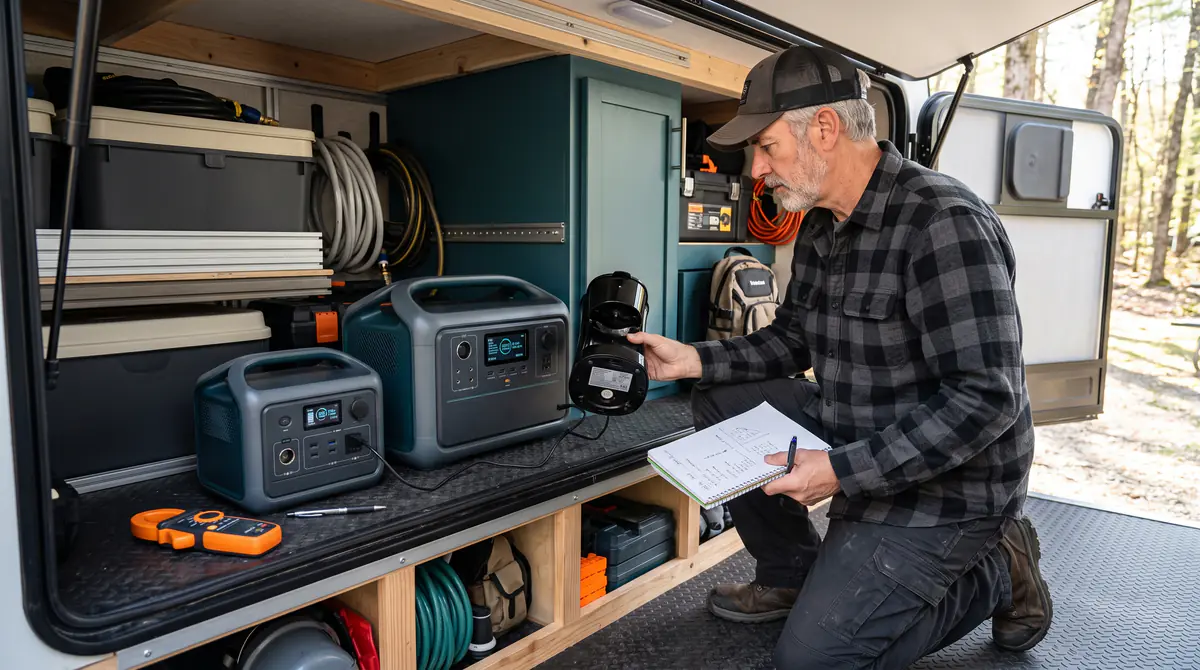
N300 vs N1000: Which One Fits Your RV?
Choose the N300 If…
- You prioritize portability.
- You mainly charge electronics.
- Your connected loads stay below 300W.
- You only need power for shorter periods.
- You already have another backup power source.
Choose the N1000 If…
- You need longer runtimes.
- You work from your RV.
- You need portable refrigeration.
- Your appliances exceed 300W.
- You want substantially more solar input capacity.
Can Either GEYOTO Run an RV Refrigerator?
Possibly, but “RV refrigerator” covers several very different appliances.
- A 12V compressor refrigerator may be a reasonable match when its average energy use and startup requirements are known.
- A residential refrigerator may fit within the N1000’s output but still consume the battery quickly depending on size, ambient temperature and cycling.
- An absorption refrigerator operating on AC may be an inefficient use of limited battery storage compared with propane operation, where permitted and safely configured.
Do not choose from the refrigerator’s name alone. Find its running watts, startup requirement and expected daily energy consumption. Then add a safety margin for hot weather, door openings and other connected devices.
Solar Charging: Why Panel Wattage Is Not the Whole Story
The N300 accepts up to 140W of solar input. The N1000 accepts up to 800W. Those input ceilings are useful, but the number printed on a solar panel is not what you will receive throughout an entire day.
Shade, wildfire smoke, cloud, heat, panel angle, dirt and shorter winter daylight all reduce production.
Our own early solar attempts taught us that lesson the expensive way. A system can look reasonable on paper and still lose ground every day when consumption exceeds replenishment.
For a broader explanation, read our beginner’s guide to RV solar power. You can then enter your actual appliances into the Everything RVs Solar Power Hub and calculator.
Decision Checklist Before You Buy
- List every device you expect to operate.
- Record its running wattage and startup demand.
- Estimate how many hours each device will run per day.
- Add the daily watt-hours together.
- Add at least 20% planning margin for conversion losses and uncertainty.
- Confirm the highest simultaneous load remains below the station’s continuous output limit.
- Confirm startup demand remains within the manufacturer’s permitted peak behaviour.
- Create a realistic charging plan using wall power, vehicle charging, solar or a generator.
- Verify shipping, returns and warranty coverage for your region.
Compare GEYOTO Power Options
Review the GEYOTO brand, compare its portable power stations and calculate your actual RV energy requirements before choosing a model.
Explore GEYOTO for RV Use Calculate Your RV Power NeedsFrequently Asked Questions
Is the GEYOTO N300 big enough for RV camping?
It can be enough for phones, laptops, cameras, lighting and other small electronics. Its 300W continuous output and 256Wh battery make it less suitable for larger appliances or longer runtimes.
Is the GEYOTO N1000 a whole-RV power solution?
Not automatically. It can run many individual appliances, but an RV connected as a complete system may introduce several simultaneous and background loads.
How long will the GEYOTO N1000 run an RV refrigerator?
Runtime depends on the refrigerator’s average wattage, compressor cycling, startup demand, ambient temperature and other connected loads. Your appliance label and measured consumption provide stronger planning information than a general estimate.
Can the N300 or N1000 be used indoors?
The stations do not burn fuel or produce generator exhaust. They must still be used and charged according to the manufacturer’s instructions, kept dry, ventilated and operated within their stated temperature limits.
Can I charge a GEYOTO power station while using it?
GEYOTO states that both models support pass-through charging. Follow the operating manual and confirm that your connected equipment is appropriate.
Which GEYOTO model is better for remote work?
The N300 may suit shorter laptop sessions and device charging. The N1000 provides considerably more energy and output capacity for a laptop, printer, router and longer workdays.
Sources and Further Reading
Written by Jeremy Denesovych
Jeremy and his family spent four seasons operating campgrounds while living and travelling in their RV. His recommendations are shaped by firsthand experience with campground power, solar limitations, generator dependence and maintaining a working mobile office.


Leave a Reply